
A word before you begin.
What follows has been assembled from station logs, work orders, request-line tickets, the margins of a clipboard nobody is allowed to ask about, the testimony of eight musicians who disagree about almost everything, and one security camera whose archive accuracy has been officially rated emotional.
Some of it is true. Some of it is true in spirit. All of it is held together with zip ties.
Where the people of Braaptopia disagree, both versions have been kept, because choosing one would only start an argument, and the last argument of that kind ran for three days and ended with a new shed. Some things on this island are not meant to be explained. They are meant to be noticed.
PrologueConcerning Braaptopia
There is an island out in a wide blue bay, where the water is the color of a swimming pool somebody forgot to drain and the air smells of two-stroke oil, sunscreen and kielbasa, in proportions that change with the wind. On a clear day you can see the mainland on one side and Far Harbor on the other. Between them, sitting out in the water as though it wandered there once and never found a good reason to wander back, is Braaptopia.
We have been asked, over the years, what Braaptopia actually is, and we have given every answer we could think of. It is a resort. It is a motorsport park. It is a radio station with an island attached, or an island with a radio station attached, depending on who is doing the attaching. One visitor described it as "a series of bad ideas that somehow achieved infrastructure," and wrote it in the guest book, and several of us were quietly pleased. All of these answers are correct. None of them is complete. The island is larger than any one sentence about it, which is a lesson the brochure department learned the hard way.
Here is what can be said with confidence. There is a purple lodge on a hill with a porch above a pool. There is a garage containing five machines that go much faster than is reasonable over surfaces that were never consulted. There is a broadcast tower roughly eleven hundred feet tall, wearing more antennas than any tower should, like a man who cannot say no to a hat. There is a bar called the Loose Bolt, a house band that came for a weekend and is still here, a maintenance shed where temporary repairs go to retire, an air service run by a man whose initials are WTF, and a jet-powered yacht whose main contribution to public safety has been to make flying look reasonable.
There are no bridges. This was a decision. People here are proud of it the way other towns are proud of a courthouse.
And over all of it, there is a voice. It comes out of every speaker on the island, every dashboard, every helicopter headset, and at least one cooler that has been examined by three separate engineers and definitely does not have speakers in it. It is Braaptopia Radio. It was on the air before anything else on the island was finished, and it has never gone off the air since, chiefly because nobody can find the switch and the people who might know where it is have all been asked not to touch it.
The Three Laws
Every civilization has laws. Most of them have a great many, filed in binders and argued over by people in good shoes. Braaptopia has three. You will find them painted on signs, chanted at the end of songs, and written in permanent marker on the inside of at least one toolbox lid, which is the island's highest court:
NO PLAN.
FULL SEND.
NO PROBLEMS.
Visitors sometimes object that these are not laws so much as a description of the weather, and they are right, and it makes no difference. Nobody on Braaptopia decided to live by them. People simply noticed, usually around their second afternoon, that they had been living by them for some time, and that it was going surprisingly well.
There is also a motto over the main gate, in letters three feet tall:
BRAAPTOPIA
PLAY DIRTIER
And there is a claim the radio station makes at the top of nearly every hour, which has been tested many times, with considerable enthusiasm, and never once disproved:
BRAAPTOPIA RADIO
MORE HITS THAN THE GUARDRAIL
Concerning the Sound
You will hear the word before you understand it, and you will understand it before anyone gets around to explaining it, and by the time somebody explains it you will not need them to.
Braap. It is the noise a dirt bike makes coming out of a berm with the throttle pinned. It is the noise a trophy truck makes on landing, and the noise the passenger makes shortly after. It is what the house band's frontman says into the microphone when the song needs one more thing and nobody can agree what. It is a greeting, a farewell, a warning, a round of applause, and on one documented occasion a complete technical explanation offered to an engineer, who accepted it, because it was correct.
When the tower lights the great sign at its peak (with a courtesy whoomph of flame, available on request, though nobody can remember anyone requesting it) that is also a braap. When the frontman stretches the word out to its full natural length, it becomes BRAAAAAAAAAAP, and the gulls leave, which the gulls have come to regard as their part in the arrangement.
Newcomers sometimes ask about the utopia half of the name, because nothing on the island is perfect, nearly everything is held together with something it was not designed to be held together with, and at least one warning light is always on. But a utopia, as any of us would tell you if we could stop working long enough, is not a place where nothing goes wrong. It is a place where the people who live there have decided that what goes wrong is interesting. The machines are excessive. The repairs are provisional. The music is excellent. And everyone, without exception, has a job.
Whether anyone is officially employed is another matter, and one we will come to.
Concerning the People
They are, on first acquaintance, alarming.
There is a heavyset man in a red Hawaiian shirt and a broadcast headset who appears wherever something is happening, and in several places shortly before it does. There are eight musicians who look as though they were stitched together out of canvas, rubber and road-worn denim in a maintenance shed at two in the morning, which they deny, mostly. There is a weathered mechanic who knows why everything leaks and resents being asked. There is a dispatcher who says "probably" the way bankers say "guaranteed."
But here is the secret of Braaptopia, and you should know it before you go any further: every one of them is extremely good at what they do.
The man in the headset is a broadcast veteran who can keep a station on the air through a fire, a flood and a goat, and has, in that order, on a Tuesday. The mechanic can get anything running and once got a lawn mower running that had been specifically retired. The keyboardist can fix an intermittent fault with one finger. The woman at the parts counter can diagnose an engine from the noise a guest makes with their mouth, and can also tell from the noise which part of the story the guest is leaving out. The dispatcher can route a heavy-lift helicopter, a medical evacuation, a seaplane and a delivery van through one afternoon without anyone ending up in the water who did not mean to, which, on this island, counts as a perfect day.
So the comedy of Braaptopia (and it is a comedy; we have never pretended otherwise) is never that these people do not know what they are doing. It is that they know exactly what they are doing, have considered the alternatives carefully, and are doing it anyway, with vice grips, at full throttle, while the radio plays something that makes the toolbox walk across the bench.
Concerning How People Stay
Nobody comes to Braaptopia intending to stay. Everybody will tell you that, and they will tell you with such conviction that you will begin to suspect it is the island's oldest joke.
A band was booked for three nights. A pilot stopped for fuel. A visitor, much like yourself, came through the gate to drive a rally car around in the mud and perhaps hear a few songs.
And then something happened, as something does. The bus wouldn't start. Somebody handed the pilot the airfield keys before his coffee was cool enough to drink. And Engineering noticed the visitor standing near a rack that was making an unusual sound, and concluded, by a process nobody has ever been able to fault, that the visitor was now the nearest available engineer.
The island has a saying about this. It is painted on the wall of the Maintenance Shed in the patient capitals of a man who has explained it many times and would prefer not to explain it again:
NOBODY'S OFFICIALLY EMPLOYED.
EVERYBODY HAS A JOB.
An early visitor compared the place to that old song about the hotel you can check out of but never leave, "only friendlier, louder, and held together with vice grips." This is not quite right, and if you repeat it here somebody will correct you, kindly, at length. You can leave Braaptopia. The gate is right there. The boats run. The planes fly, mostly on schedule.
It is just that there is always one more song. One more lap. One more thing that needs fixing, and you happen to be the person standing nearest to it, and it seems a shame to walk away from it half done. And then it is Thursday.
ON AIR · BRAAPTOPIA RADIO
Hey hey, good afternoon and welcome to Braaptopia Radio, More Hits Than the Guardrail, coming to you live from a rack that has passed every inspection we have not scheduled.
If you're just tuning in: you're not. You're tuning in in the middle. We were already going. We're always already going. That's how radio works, and frankly, that's how this whole island works.
Somebody just handed me a note that says the new arrivals are reading the book, which, I didn't know we had a book. Who wrote the book? Is it the clipboard? Did Webb finally let somebody read the clipboard? No? Okay. Okay, I've been told that's still a no.
Anyway, folks, welcome. Pull up a cooler. Don't touch anything labeled TEMPORARY. Here's one that absolutely rips.
Chapter OneYou Have Arrived a Little Early

Every visitor to Braaptopia arrives slightly too early. This is not your fault, and nobody will hold it against you. Everybody arrived slightly too early, including the island.
In the beginning (and people here do say in the beginning, the way people in other towns say before the new post office) there was only a sign at the gate and a radio signal coming from somewhere over the hill:
WELCOME TO BRAAPTOPIA RESORT
YOU'RE A LITTLE EARLY.
Braaptopia will be open soon.
Braaptopia Radio is already out on the tracks testing the transmitters. Hang around, turn it up, and get a preview of what's coming through the gates.
The resort did open, eventually, in the way Braaptopia does everything: gradually, then suddenly, then with a sign announcing that it was open probably. But the habit stuck. The station still behaves as though you have walked in on the middle of something, because you have. When you first arrive, the music does not start at the beginning of a song. It starts somewhere near the end of one, mid-chorus, as if the station had been playing for hours before you came through the gate and had no intention of starting over just because you showed up. This is accurate. The station has never once started over for anybody, and it is not going to begin with you.
The Road In
You come in from outside the gate, on the road, facing the arch.
For a long time this was not the case. For a long time visitors simply appeared somewhere behind the entrance, already inside, as though they had always been there, and not one of them ever saw the sign. A meeting was held. It was agreed that a place like Braaptopia ought to be arrived at, the way you arrive at a county fair or a family reunion, with a moment on the road where you can still turn back and don't. So now you begin nineteen paces outside the great arch, with the island laid out ahead of you under a sky so blue it looks like it was touched up later, and the gate sign towering over everything:
BRAAPTOPIA
MORE HORSEPOWER THAN GOOD JUDGMENT
Parked on the road beside you is a small teal-and-cream resort buggy, and its keys are in it. Its keys are always in it. This is a policy, and like most policies on Braaptopia it arose from a problem and was then improved past the point of the problem. The problem was that people kept losing the keys. The first solution was a hook by the gate. The hook was lost. The second solution was a lockbox. The combination was lost, along with, briefly, the lockbox. The third solution, which has worked perfectly for years, was to leave the keys in the buggy, on the grounds that nobody has ever lost a set of keys that were still in the ignition. A sign records the outcome:
WELCOME. PROBABLY.
TAKE THE CART. WE LEFT THE KEYS.
You will get in. Everybody gets in. And as you settle into the seat, a voice from somewhere (it is never clear where) will offer the closest thing Braaptopia has to a legal disclaimer:
Keys are in it. Try not to make that our problem.
Getting Lost on Purpose
There is a map of the resort, and it is lovely, and it will not help you. Its heading reads YOU REALLY CAN GET THERE FROM HERE, which is technically true of anywhere. Its title reads Your kind of wrong turn. And the little location label in the corner of your eye will never say anything more specific than:
YOU ARE SOMEWHERE NEAR
People assume this is because the staff do not know where you are. The staff know exactly where you are. They have simply observed, over many seasons, that visitors who are told precisely where they are go precisely where they meant to go, and miss the pool, the band, the shed, the truck behind the Garage, and nearly everything else worth seeing. Visitors who are only told they are somewhere near wander, and wandering is how people end up staying. Nobody planned this. It just turned out that the least helpful map on the island is also the most effective recruitment tool.
The road that loops the resort is signposted RESORT LOOP, and under that, smaller, TAKE THE LONG WAY. When you stray between destinations, the island reminds you that you are on the scenic route, and that the radio is on. Both of these will remain true for as long as you are here.
The ground is mostly grass, worn to sand around every building, so the island keeps an honest record of where people actually go. Little guest shacks, painted every color a can of discount paint is capable of, sit around the perimeter looking relaxed and slightly sunburnt.
And over the tops of the palms you will see the tower. You cannot fail to see the tower. People have tried. We will come to the tower.
If you would rather walk, you may. Climb out and the island invites you to stretch your legs; the buggy will be right where you left it, with its keys. Walk all the way around it if you like. People do. When you get back in, the island greets you with the quiet confidence of something that has seen what you do with machinery:
Back behind the wheel. An excellent decision, probably.
And if you ever become truly, thoroughly lost, the island will lift you gently back to the arch with a note that manages to be both forgiving and accurate:
Back at the entrance. Fresh start. Same judgment.
What You Will Find
Here is some of what a buggy with good intentions and no map discipline will discover.

The Purple Lodge sits on the hill, the heart of the resort, glowing like a sunset that applied for a building permit. It has a porch above the pool and stands just far enough from the tracks to pretend you came here to relax. Inside is reception, where a heavyset man in a headset will welcome you with both arms and point you at the brochures, all of which he has, at some point, appeared in.
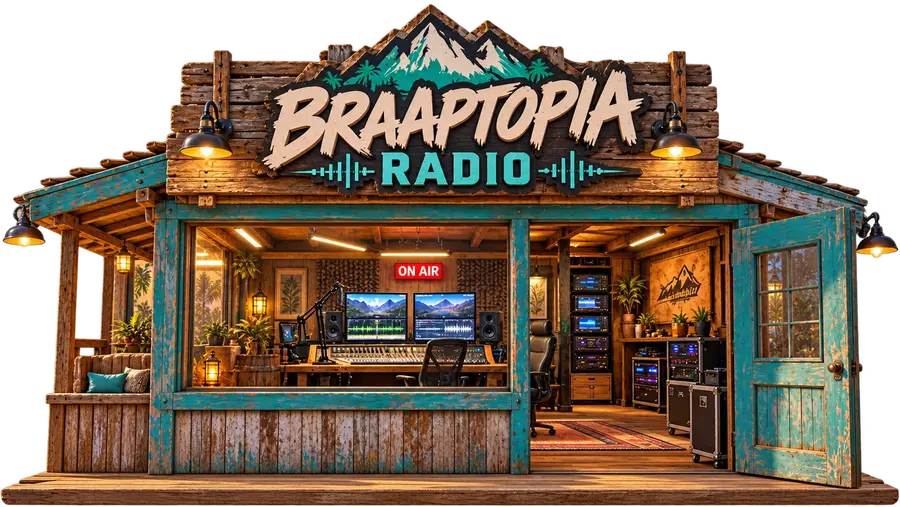
Braaptopia Radio is a weathered wooden studio with a porch and a door that is always open. The ON AIR light is always on. Nobody has tested what happens if it goes off, and nobody intends to.
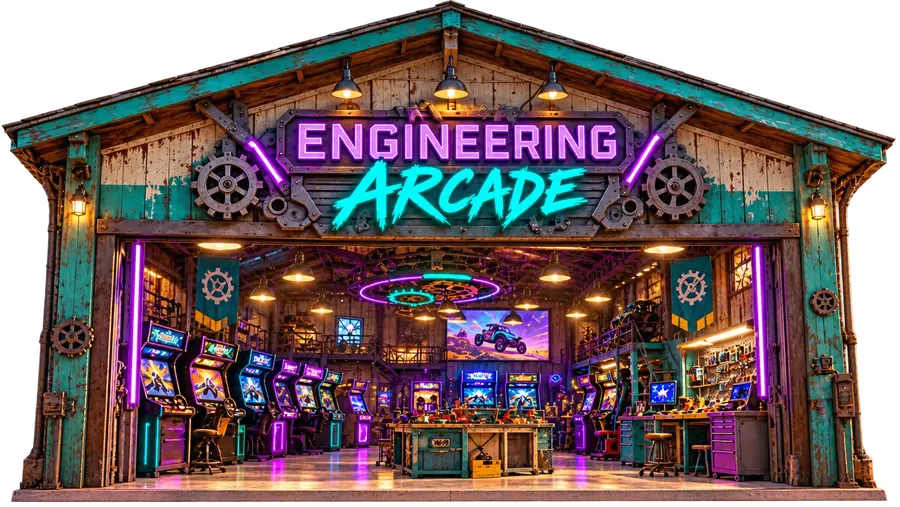
The Engineering Arcade glows with purple neon and contains, in the words of its own sign, a room full of things that worked until somebody touched them.
The Pool is officially closed. It is also occupied. These facts have coexisted for years without either one giving ground.
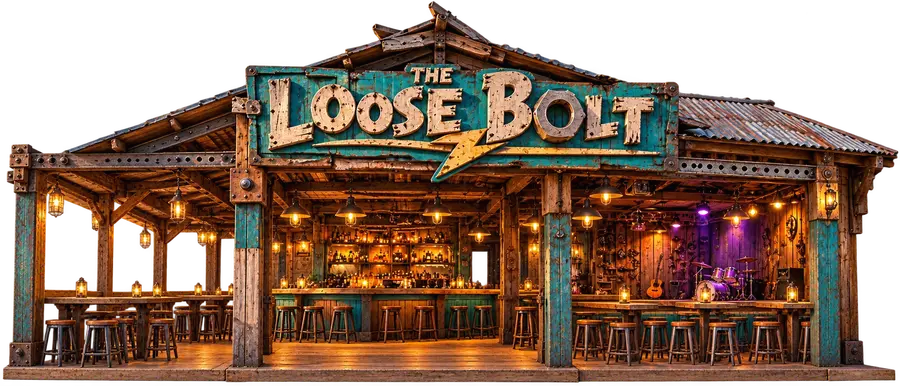
The Loose Bolt is a restaurant and club with string lights and a patio, where the kitchen closes when somebody finds the keys, which is a different set of keys from the buggy's, and better hidden.
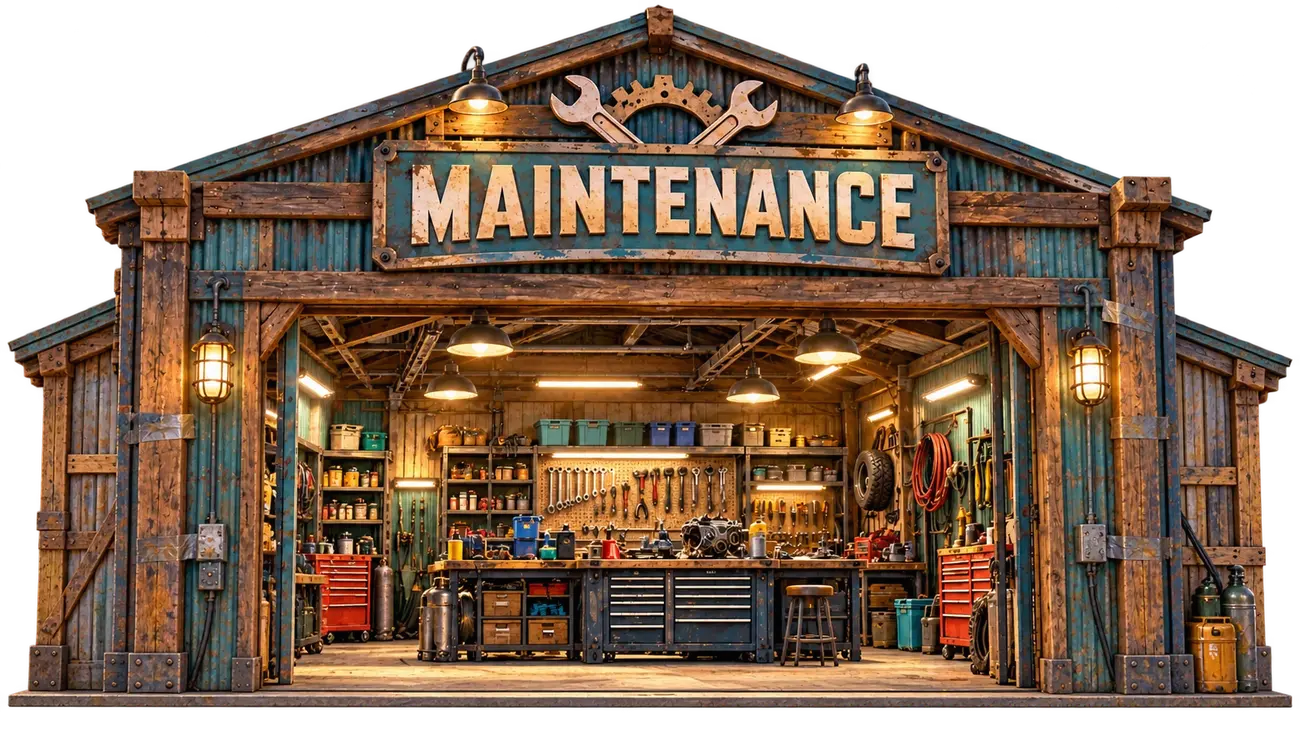
The Maintenance Shed is where questionable ideas begin, and behind it is parked a tour bus that is also a boat, waiting patiently for a part.
The Flight Base sits by the water with a helipad and a seaplane dock, and a man leaning on a fence post with a coffee mug who will tell you that everything flight-wise goes through WTF, and then wait for you to work it out.
Two enormous hotels, East and West, rise on either side of the island like bookends holding up a very disorganized shelf.
Five great arches stand at the island's edge, each the gateway to a track: Rally, Trophy Truck, SXS, ATV and Dirt. Beyond each arch the road runs toward a painted horizon of mountains and dust, and from just the right angle it seems to go on forever. From the wrong angle, you will find out how painting works. Most people choose the right angle. It is a better way to live.
And everywhere, over everything, from the buggy's dashboard and the speakers on the lamp posts and the open windows of the lodge, comes the radio.
ON AIR · BRAAPTOPIA RADIO
We've got new arrivals at the front gate, I can see the buggy from here. Welcome, welcome! Couple of things. Number one, the keys are in it. Number two, yes, you can drive on the grass, but Otis is going to look at you. He's not going to say anything. He's going to look at you.
Number three: if you see a sign that says the resort is open, probably, that sign is correct.
This next one's going out to everybody who just pulled through the gate and immediately took a wrong turn. That's all of you. That's everybody. That's the whole point. Here's Braaptopia Radio.
A Note on Postcards
There is a camera mode on the island, and the people of Braaptopia take it seriously. At any moment you may stop, frame the view, and take a picture. It is called a POSTCARD FROM BRAAPTOPIA, and when you save one the island signs it for you:
POSTCARD SAVED.
WISH YOU WERE QUESTIONABLE.
You may choose the hour, too: GOLDEN HOUR, HIGH NOON, or AFTER HOURS, when the string lights come on at the Loose Bolt and the band, which finished hours ago, has still made no convincing attempt to leave.
Chapter TwoConcerning Zip Ties, Vice Grips, and the Ten-Millimeter
Every great civilization is built on something. Rome had concrete. Egypt had very patient people moving very large rocks. Braaptopia has zip ties, and is not ashamed, and would point out that Rome is not currently broadcasting.
You will notice them once you start looking, and then you will be unable to stop. They hold the cable bundles together behind the racks. They hold the antenna brackets to the tower. They hold the signs to the fences and the fences to the posts. They are cinched around things that should have bolts, and around the bolts of things that should have welds, and in one place, around a weld, as a precaution. A recent bulletin reported that the tower base cabinet now contains 14% more zip tie, and the significant thing is not the number but that someone measured it, and the more significant thing is that nobody asked what it was 14% more than.
EAS UPDATE: ZIP TIES APPLIED IN A MANNER BEST DESCRIBED AS STRUCTURAL.
A member of the tower crew, asked about this directly, said: "The zip ties are structural now." He did not say it as a confession. He said it the way a man tells you his son made partner.
The Holy Trinity
There are three materials the people of Braaptopia regard with something near reverence. Visitors sometimes take this for a joke. It is not a joke. It is supply chain.
Zip ties first and always, in every color and length, ordered by the planeload. The logic of the planeload deserves a moment, because it is sound. A zip tie is cheap. A flight is not. Therefore, the cost per zip tie of a flight falls as the number of zip ties on it rises, and keeps falling, and at a certain point the zip ties become very nearly free, provided you are willing to own an extraordinary number of them. Braaptopia was willing. It has been willing for some time. When the station cannot find a sponsor, which is always, the zip ties fill the gap:
THIS SWEEP PRESENTED BY ZIP TIES: AGAIN, NOT A SPONSOR, JUST LOAD-BEARING.
Duct tape, which the station also declines to call a sponsor, preferring not a sponsor, just present. There is currently one roll left in the main building. It has been placed under armed cultural protection. Duct tape was moved to controlled inventory after the lunch incident, which is never described, and which everyone who was there describes differently, so the incident has become, over time, four or five incidents, all of them at lunch.
Vice grips, which are the nearest thing Braaptopia has to a currency. A pair of vice grips will hold anything to anything, and so they are always holding something, and so they are never where you left them. At any given moment they are clamped to three unrelated objects, which allows the inventory clerk to record them as all out and technically restored on the same afternoon without lying once. The accounting office once considered whether one particular pair should be capitalized as a long-term asset due to unusually long service life, and the question is still open, because the vice grips are still in service. The house band's logo is a pair of vice grips wrapped in zip ties. The Maintenance Shed's motto reads:
BUILT ON BAD IDEAS.
HELD TOGETHER WITH VICE GRIPS.
The Ten-Millimeter
And then there is the socket.
You cannot understand Braaptopia without understanding the ten-millimeter socket, and you cannot understand the ten-millimeter socket because nobody can find it. In every toolbox on the island it is the one size missing. It is also the one size everybody needs. This is not a coincidence, and the island's mechanics have a theory about it that runs roughly as follows. Ten millimeters is the most common size on any modern machine. So it is the socket most often in use. So it is the socket most often set down somewhere other than the toolbox. So it is the socket most often lost. So the more useful a socket is, the less likely you are to have it, and the ten-millimeter is the most useful socket there is, and therefore, by perfectly sound reasoning, it does not exist. People call the request line wanting something loud enough to find a 10mm socket. The paddock reports that someone borrowed a 10mm and the search has entered day two. The announcer at the Zip Tie Depot Nationals opens the event by telling everyone to find your 10 millimeter sockets, the way other events open with an anthem.
Once, the parts counter found three ten-millimeter sockets at the same time. Ruby filed it as a security incident, on the reasoning that three ten-millimeter sockets in one place could only mean someone had been hoarding, and that was worse than losing them. On another occasion the search was suspended after the discovery of four eleven-millimeter sockets that nobody had bought, which nobody has explained, and which Ruby keeps in a separate drawer, labeled.
If you look carefully in the Maintenance Shed (on the workbench, in plain sight, exactly where anyone would look first) you will find it:
THE MISSING 10 MM
It was on the workbench the whole time. Nobody is prepared to admit this.
Found: the 10 mm socket.
Nobody will thank you. Some people will look away. Within the week it will be missing again, and the mechanics will regard this as proof of their theory.
Concerning Temporary Things
In most places temporary means for a little while. On Braaptopia it is a legal category, like residential, and has about as much to do with time.
The patch bay at the radio station is full of cables labeled TEMPORARY. They have been there since 2009, which makes them older than several of the people who have been told not to touch them. A temporary ground strap has, by recent count, achieved seniority. A temporary patch cable is eligible for retirement benefits, and if it ever takes them the station will go off the air, so it has been asked to stay on through the end of the year, every year. Engineering routinely announces that a temporary fix is entering permanent service, with the satisfied air of a parent at a graduation. Vern, the guitarist, sorts all of his repairs into exactly two categories, temporary and temporary with paint on them, and if you ask him whether paint makes a repair permanent he will look at you as though you have asked whether a hat makes a man taller.
There is a rule of thumb you will hear often, usually from somebody holding vice grips:
If the repair holds until lunch, it counts as permanent.
It is worth noticing what this rule does. It sets the bar for permanence at lunch, and lunch comes every day, which means every repair on the island is re-certified as permanent daily, as long as it lasts until noon. Nobody designed it this way. It is simply the most efficient quality-assurance program anyone has ever accidentally invented.
And on the wall of the Maintenance Shed, the corollary:
Nothing here is temporary. Especially the temporary repairs.
Concerning Inspections
Braaptopia takes inspection very seriously, in the sense that it has passed all of them.
The station broadcasts live from a rack that has passed every inspection we have not scheduled, and people who hear that for the first time laugh, and then, on reflection, find they cannot argue with it. An inspection that has not happened cannot be failed. The station has never scheduled one. The station has a perfect record. The tower ladder has likewise passed every inspection we did not schedule, and so has every other thing on the island anyone has ever asked about.
In the Garage, on one of the vehicles, there is a dashboard where every single warning light is lit at once: oil, temperature, battery, brakes, engine, and several lights whose meaning has been lost to history. Somebody has applied a handwritten sticker beside them:
QUALITY CONTROL
A dashboard with every warning light illuminated. A handwritten inspection sticker says: FESTIVE. PASSED.
Every light red. Green to me.
Festive is the important word. Somebody looked at a dashboard full of red lights and saw, not a list of problems, but a celebration, and the island agreed with them, and the sticker has never been removed. Every light red, but it's green to me is a line from one of the island's songs, and something of a creed. It is not that the people of Braaptopia ignore warnings. They read the warnings. They think about them. They decide to keep rolling, and they are usually right, which is the part outsiders find hardest to forgive.
IF IT RATTLES, LET IT RIDE.
There is a safety director, technically. Near the main entrance you may find the paperwork for the island's current risk assessment. The box for EVENT SAFETY DIRECTOR has been filled in with the words Going great. The signature beside it appears, on close inspection, to be a tire mark.
RISK ASSESSMENT
EVENT SAFETY DIRECTOR: Going great. The signature appears to be a tire mark.
Risk assessment approved.
There is also an old engineering standard, said to go back to the very first bridge on the very first track, which holds that if a structure looks as though it can hold a vehicle for approximately 1.7 seconds (roughly how long it takes to cross at speed), then that structure is certified. People from outside are horrified by this. People from here point out that it is the only engineering standard in the world that is measured against how the structure is actually used, and that nobody has ever lingered on one of those bridges long enough to test the 1.8th second, and that if they did, that would be on them.
Concerning Paperwork
Paperwork on Braaptopia does not record authority. It creates it.
A credential is anything you have written on a piece of cardboard and hung around your neck. A signature is any mark made with sufficient conviction. A form is complete when somebody has stopped asking questions about it. The compliance office, which according to its own records consists of two people whose names both point to the same mailbox, has produced several landmark documents, and has certified, among other things, its own ability to certify:
COMPLIANCE — CERTIFICATION We certify that we reviewed the certification certifying that we can certify ourselves.
COMPLIANCE — SIGNATURE PAGE Signature present. Name illegible. Authority therefore considered strong.
COMPLIANCE — DOCUMENT RETENTION Nobody knows how long to keep it, so we are keeping all of it forever.
At the end of a long day of inspections, after everything has been examined and tested and signed (or at least looked at in a manner suggesting examination), the island's official finding is always the same:
All inspections complete. No problems found.
And under it, in smaller letters, the filing instruction:
Filed under: nobody needs to know.
Concerning Steve
Steve has not worked here in eight months.
We mention this because you will encounter Steve. Not Steve himself; nobody has seen Steve himself in eight months. But you will encounter his presence, which has outlasted him in every department. There is a container in the break-room refrigerator labeled STEVE that still attends daily. There is a pudding cup in that refrigerator that belongs to Steve and has seniority, and the fridge has been told so in writing. There is a shelf labeled Steve, a box marked STEVE blocking the cabinet Engineering most needs to reach, and an access badge belonging to Steve that the building's security system still considers active, which means that, on paper, Steve has better access to the station than most of the people who work there. Steve's exit interview was scheduled for eight months after his departure. Steve was unavailable. When the station's social media engagement rose two hundred percent, analysts observed that the baseline had been one person and may have been Steve.
Nobody knows where Steve went. Nobody is worried. If you think about it, Steve is the only person in the history of Braaptopia who actually managed to leave, and the island has responded to this the only way it knows how, by keeping his things exactly where he left them, just in case.
Chapter ThreeThe Man in the Headset
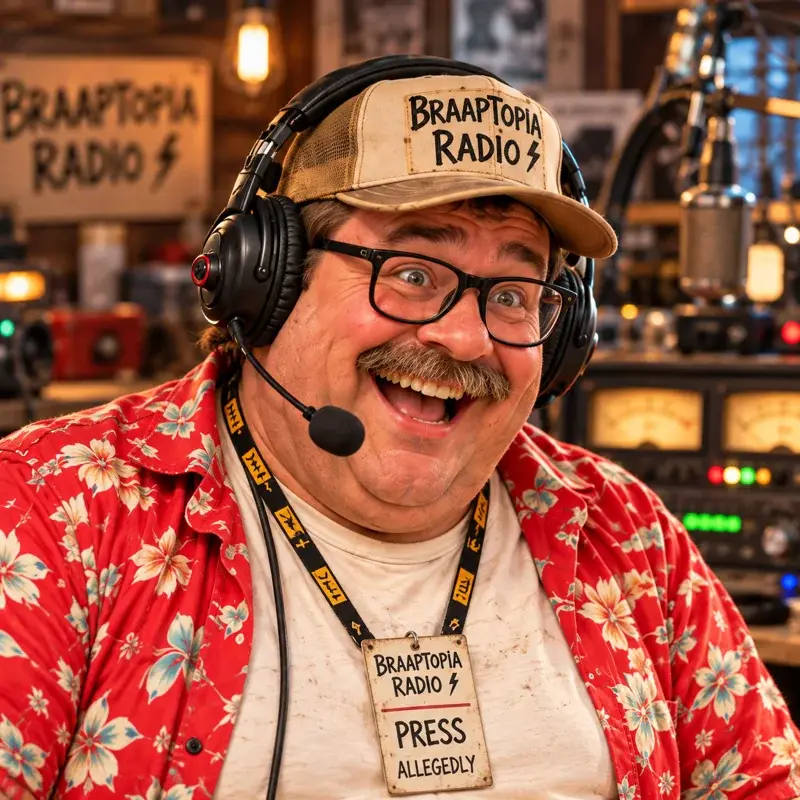
Nobody knows his name.
This is not a figure of speech, and visitors are slow to believe it. They assume it must be written down somewhere, on a payroll ledger or a station license or the back of one of his many badges. It is not. Radio people, the island will tell you, have always gone on the air under names that were not quite their own, and this one simply followed the tradition to its logical end and stopped needing one at all. Everyone calls him Radio Guy. He answers to it. Ruby once tried to fill in his full name on a parts requisition and, after some thought, wrote RADIO GUY in the box, and the supplier shipped the part, and that, as far as the island is concerned, settled the matter legally.
You will meet him almost at once. He is a big, round-faced man somewhere around fifty, with a thick brown mustache, heavy black glasses, and a grin that arrives a moment before the rest of him. He is very heavyset and carries it the way a good armchair carries its stuffing. He wears a red Hawaiian shirt over an undershirt that has seen things it will not discuss, cargo shorts, work boots, and a BRAAPTOPIA RADIO trucker cap.
And on his ears, always, always, the headset.
The Headset
The headset is the most important thing about him, and the key to understanding why he is everywhere.
He wears it in the studio and trackside, which makes sense, and also while racing, wrenching, cooking sausages, and climbing an eleven-hundred-foot tower, which makes a different kind of sense. When a job truly requires a helmet or a welding hood, the headset comes off, but only for exactly as long as it must, and the moment the helmet is off the headset goes back on, like a man putting his glasses on after a swim.
The reasoning behind this is airtight, and the island has never found a hole in it. If he is wearing the headset, he is on the air. If he is on the air, he is working. If he is working, he is entitled to be wherever the work is. And because a radio man's work is to go wherever something is happening, and something is always happening somewhere on Braaptopia, it follows that Radio Guy is entitled to be anywhere at all, at any time, provided the headset is on. Nobody has ever successfully asked him to leave a room. They have tried. He points at the headset. They nod. It is, everyone agrees, a fair point.
So the question on Braaptopia is never why is Radio Guy here? The question is where is Radio Guy going to turn up next? And people make small wagers on it.
The Badge
On a lanyard around his neck, bouncing off his belly when he laughs (he laughs often), hangs his press pass. It is handmade. It always looks handmade. It is a scrap of card lettered in marker, laminated badly or not at all, and what it says depends entirely on what job he has given himself today.
He is, you see, the man who appointed himself station manager. And having appointed himself to one position, he discovered something nobody had thought to warn him about, which is that the process was very easy to repeat. There was no form. There was no committee. There was a marker and a piece of cardboard, and nobody to tell him no, because the only person with the authority to tell him no was, by then, him.
The most famous version of the badge you can find for yourself, if you look closely at him in the studio:
THE ACTING DIRECTOR
Radio Guy's credentials read: ACTING DIRECTOR. Underneath, in smaller handwriting: NOBODY ELSE SHOWED UP.
Credentials inspected.
But there are others. Visitors who have been on the island a while report seeing him wear, at one time or another:
BRAAPTOPIA RADIO
PRESS
Allegedly STATION MANAGER
Nobody voted ALL ACCESS
PIT CREW CERTIFIED TECHNICIAN
Certified by me AUTHORIZED PERSONNEL
Probably ARTIST LIAISON
They don't know yet AIR CREW
Looked easy OFFICIAL INSPECTOR
Trust me
The badges change. The man does not. It has been observed by more than one long-term guest that his credentials become progressively less credible as his confidence increases, and that his confidence has never once, in recorded history, gone down. Mabel keeps a few of the retired badges in a shoebox, for reasons she does not share.
What He Is Not
Here is where visitors usually get Radio Guy wrong. They see the shirt, the grin, the badge that says CERTIFIED BY ME, and they decide he is a clown, a mascot in a headset.
He is not.
He is a veteran broadcaster, thirty-odd years behind a microphone, with the timing and instincts only decades of live radio produce. He knows his way around a transmitter. He knows what a reflected-power reading means and why you don't want it looking at you funny. He can keep a station on the air through an equipment fire, a generator tantrum, a band invasion and a goat, and has, though not all on the same day, except once. When the rack catches fire (and the rack catches fire) he is not standing there helpless. He is delighted. He is thrilled. He has seen this before, he knows what to do, and what he knows to do usually involves somebody hitting something until it remembers its job.
There is a line, recorded early in the island's history, that describes him better than any badge:
"This is probably a terrible idea, and I am DELIGHTED about it."
That is Radio Guy. He is never menacing, never helpless, never a polished corporate spokesman. He is a man far too comfortable with whatever is happening, who has concluded that whatever is happening is probably going to be great radio, and who is right more often than is fair. He gets excited. He gets distracted. He gets sarcastic. He steps on his own jokes, recovers, and keeps going. Now and then he seems to become aware that he is inside some larger story, that there are people out there watching and playing along, and he will turn and say so, cheerfully, and then go back to work, because the generator is making a new noise.
Webb, who has known him a long time, put it best. Webb said: "He's not crazy. He's just already decided." Then Webb went back to whatever was leaking.
His Many Jobs
What does Radio Guy do? It is easier to list what he doesn't. In the course of a single day he may be found:
Behind the reception desk at the Purple Lodge, arms wide, welcoming new guests and pointing them at the brochures.
Under the desk with a flashlight in his teeth, doing engineering by touch and prayer.
At a folding table at the edge of a dirt track, behind his pickup, signing competitors up for the day's races with a clipboard (sometimes upside down) and a pen that works on the second try.
Beside the barricade at the edge of a jump, much closer to the racing line than anyone would advise, headset on, microphone up, calling the action as a trophy truck sails over close enough to part his hair. His face in these moments is pure delighted disbelief, the face of a man who cannot believe what he is seeing and is already planning how to tell everyone.
In a chef's apron at a trackside grill, cooking kielbasa and Italian sausage, still wearing the headset, still on the air, because (as the whole island agrees without ever having discussed it) that is what radio people do.
He does not do all this because anyone requires it. He does it because somebody needed to, and he was nearest, and also because he wanted to, and on Braaptopia those three reasons tend to arrive together.
ON AIR · BRAAPTOPIA RADIO
People ask me, they say, "Radio Guy, how do you do all this?" And I tell 'em: I don't know. Nobody knows. That's the beauty of it.
You get a headset, you get a badge, you write something on the badge. That's it. That's the whole qualification process. Today mine says SAFETY OFFICER, which, I'll be honest with you, I wrote that about forty seconds ago, because somebody needed one and I had a marker.
Hold on, I'm getting a... is that the generator? That's the generator. That's a new noise. Engineering's calling that "texture." Okay! Okay, we're going to go to music while I go look at the texture. Here's something with absolutely no indoor voice.
Chapter FourThe Station That Was Ready First
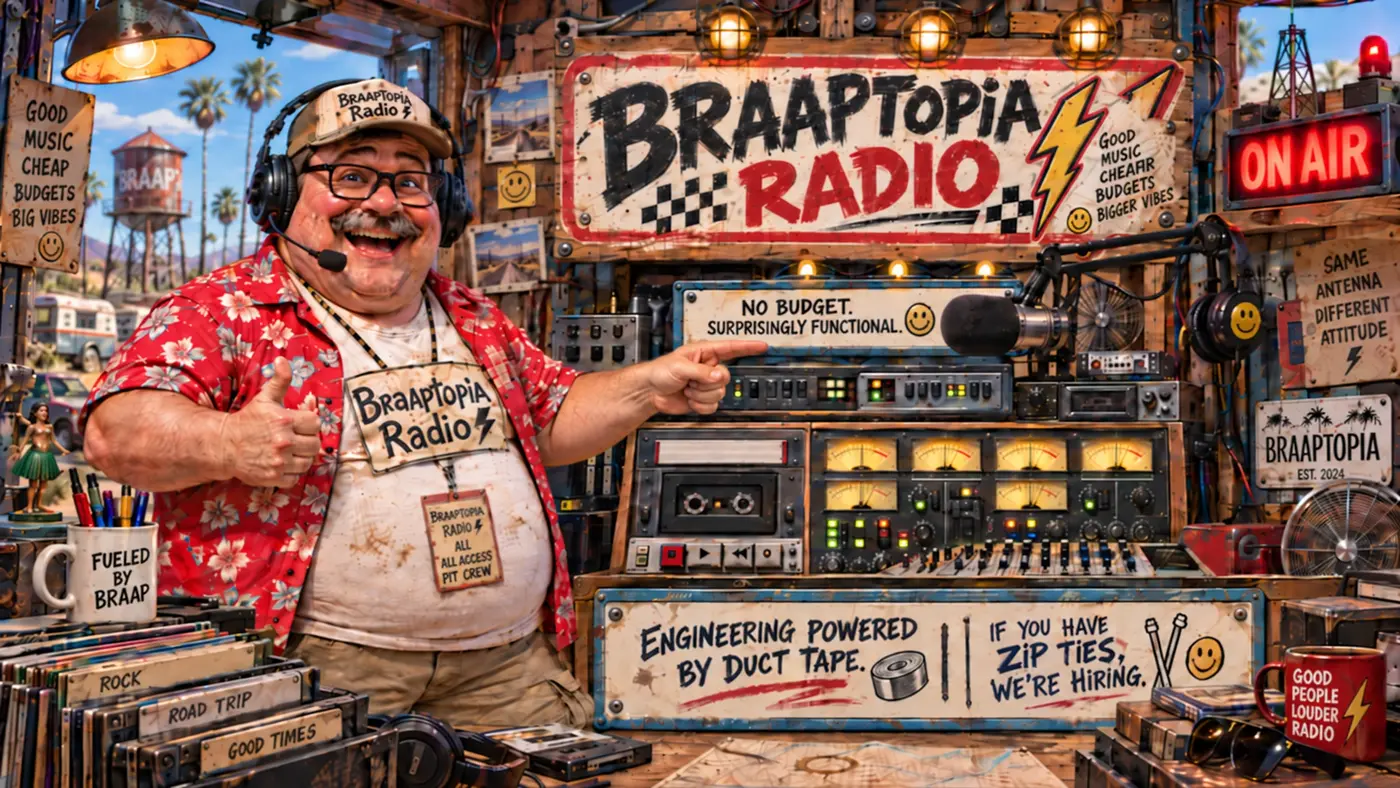
Braaptopia Radio was the first thing on the island to be ready, and it has not been entirely ready since.
The studio stands on the resort grounds with a porch out front, a hand-carved sign over the door, and an ON AIR light that has never, in living memory, been turned off. Step inside and you are standing in a broadcast shrine built from salvage and enthusiasm: cart machines stacked three high, racks of equipment with knobs from four different decades, analog meters twitching along with the music, a mixing board with half its faders labeled in marker by people who disagreed about what they were for, duct tape on everything, and cables running in all directions like the roots of a very confused tree. Over the door, carved into the wood, is the station's founding statement of fact:
The tower is up. The transmission line is completed. Still no budget, and lots of duct tape was used. Have any zip ties we could borrow?
It is worth noting that this is the only founding document on Braaptopia, and that it ends by asking for zip ties. Most founding documents end with a signature. Ours ends with a request, which tells you most of what you need to know.
And on the walls, the station's philosophy, in hand-painted letters:
NO BUDGET.
SURPRISINGLY FUNCTIONAL. ENGINEERING POWERED
BY DUCT TAPE. IF YOU HAVE ZIP TIES,
WE'RE HIRING. SAME ANTENNA.
DIFFERENT ATTITUDE.
Nobody Would Sponsor This
The station has no commercials. Visitors sometimes take this for principle. It is not principle. In the plain words of the people who run it, nobody would sponsor this, and they have checked. The sales department has been asked to stop. Its pipeline consists of one guy who said maybe. Its most recent trade agreement was for two hot dogs and a patch cable, and opinion is divided as to whether the station got the better end of it, since the hot dogs were very good and the patch cable has been in service ever since.
Where the commercials ought to go, the station simply tells you who paid for the next few songs, and the answer has not changed in years:
THIS HOUR BROUGHT TO YOU BY NOBODY. ✦ COMMERCIAL FREE BY LACK OF INTEREST. ✦ TODAY'S PROGRAMMING FUNDED BY WHATEVER WAS LEFT AFTER BUYING ZIP TIES. ✦ THIS HOUR BROUGHT TO YOU BY KIELBASA. KIELBASA HAS NOT BEEN CONSULTED.
And yet. Here is the thing. For a station with no budget, no sponsors and nothing to sell, Braaptopia Radio owns a remarkable amount of extraordinary equipment: a live audio processor labeled DON'T TOUCH THIS, a rusted industrial sampler called Test the Loud Thing, a listener-tracking screen that appears to have been built for hunting submarines, a bank of security cameras with no reliable labels, a psychedelic light show you must sign a warning to enter, and a ghost-hunting training simulator with a government-sounding acronym. The station describes itself, in its humbler moments, as basically a guy at a card table behind a pickup truck at Turn 2.
People have tried to work out how a guy at a card table came to own all of this, and the attempts tend to go the same way. The station has no money, so it cannot have bought the equipment. The equipment is here, so it must have come from somewhere. Nobody on the island remembers ordering it, receiving it or installing it, though several people remember using it, some of them on the day it appeared. The only conclusion consistent with all the evidence is that the equipment arrived of its own accord, because it wanted to be here, and the island has accepted this explanation in the way you accept a stray cat. It is considered slightly impolite to ask further.
The Station Never Stops
Braaptopia Radio does not start, and it does not stop. It was already going when you arrived, and it follows you everywhere. Walk from the resort into the studio and the song carries on. Climb into a rally car on Rally Island, or a helicopter on the Flight Base pad, or the cockpit of a jet boat on the north shore, and the radio is there, picking up exactly where it left off, as if it had simply walked over with you. If Radio Guy is the island's connective tissue, the station is its bloodstream, and like most bloodstreams it has never been formally turned off and nobody would like to find out what happens if it is.
The weather report concerns the dirt (mud in shaded areas, regret in sunlit areas). The news concerns whoever just did something spectacular on one of the tracks (somebody sent it too deep and has entered the shrubbery). And the phones never stop. Marlene calls from the lakeside dock in Michigan. Big Mike calls from a generator room in Arkansas, needing something loud enough to find a 10 mm socket. Wanda calls from a back porch in Georgia, wanting to hear what poor financial decisions sound like. They call faster than anyone can play them, which, the station feels, is exactly how a radio station should feel.
You may take it over, if you like. Press BE THE DJ in the studio and the whole library is yours to stack and put on the air. When your set runs out a notice informs you, politely, that management has retaken the board. We will come to management.
The Tower
You saw it from the road. Everyone does. The tower rises roughly eleven hundred feet, a red-and-white lattice wearing more antennas than any tower has a right to, with the great BRAAPTOPIA RADIO sign near the top, which on special occasions erupts in flame.
A visitor who knows something about broadcasting will usually stand under it for a long while and then ask the obvious question, which is why a small station with no sponsors needs a tower like that. It is a reasonable question, and the island has a reasonable answer, which goes like this. The tower has a great many antennas. Antennas need maintenance. The more antennas a tower carries, the more often one of them needs maintenance. And so a tower with a great many antennas will always have a crew on it, and a tower with a crew on it is a tower that is being looked after, and a tower that is being looked after is safer than one that isn't. By this reasoning, every new antenna makes the tower a little safer, and the island has been making it safer for years.
At the very top is a red beacon bulb. When the bulb burns out, somebody has to climb eleven hundred feet of steel to replace it. That somebody is Radio Guy, in a hard hat and a reflective harness that twinkles in the sun, slinging himself up hold by hold on his tether, swinging out over nothing when he misses, laughing, and climbing on. At the crown he stops, and the island turns slowly beneath him, the lodge and the pool and the five arches and the bay beyond, and it hits him the way it hits everyone who makes that climb: we are very, very high in the air.
How did that sign get up there in the first place? People like to ask newcomers. Some will tell you a helicopter. Some will nod toward the back of the Garage and say, how do you think?, and then change the subject.
Unfortunately, You Are Engineering
Sooner or later, every visitor to Braaptopia becomes Engineering.
It happens without warning. You are standing near the studio and a page comes over the speakers: ENGINEERING TO STUDIO. You look around for an engineer. There isn't one. A second page: waiting for somebody else to become responsible. Nobody does. Then the third, which is not urgent at all, merely final:
NOPE. STILL YOU.
ORGANIZATIONAL CHART EXHAUSTED. SEARCH RESULT: YOU.
The logic, once you see it, is beautiful. The page goes to Engineering. Engineering is whoever answers the page. Nobody else has answered the page. You are reading the page. Therefore, by elimination and with no malice whatsoever, you are Engineering, and the sign on the Arcade door is only confirming what the organizational chart has already worked out:
ENGINEERING HAS BEEN NOTIFIED.
UNFORTUNATELY, YOU ARE ENGINEERING.
Inside, Radio Guy is waiting, and he is thrilled to see you, and he means it. The work has a name, The Rack Caught on Fire.......... Again., and the dots are the sound of a man who has said that sentence many, many times. There are eight kinds of emergency, and any of them can happen before lunch. You will sort tools and burritos out of the same stockpile, since a hungry engineer near high voltage is a bigger risk than a burrito in the parts bin. You will defend the rack's magic smoke, which every component leaves the factory with and which Engineering's whole job is to keep inside. You will move a box marked STEVE out of the way of the thing that broke. And sooner or later you will discover what the intermittent fault really is, the one that only happens when nobody is looking.
It is a ghost. On Braaptopia, the ghosts go in the same work-order queue as the bad capacitors, and nobody is particularly surprised, and the ghosts, to their credit, have stopped expecting them to be.
"Keep the station on the air, keep the smoke inside the equipment, and yell if you need me. I am genuinely thrilled to have the help."
Management
Management exists. This is established. Management has an office, a calendar, and an open-door policy. The door is open. Management is not behind it.
The station's records place management, most of the time, near a lake. A recent ticket filed under EXECUTIVE UPDATE reads: Management will provide direction upon return from lake. Weather currently excellent. A leadership offsite has been confirmed; the site appears to contain a dock. The camera-on policy for video meetings was withdrawn after management joined from a boat. Strategy sessions are reported to occur near a lake with two coolers and no laptops.
It is not known who management is. It is not known whether management is aware of the station's equipment, its staffing, its finances, or the tower. The station's liability desk notes, with evident relief, that management awareness has successfully been held below actionable levels.
So the station runs itself, the way everything on Braaptopia does: on zip ties, coffee, a man in a headset, and whoever happens to be standing nearest when the rack catches fire.
Should you need the details (the sponsor crawl, the break-room tickets, the tower readbacks, the eight Engineering specialties, the button marked DON'T TOUCH THIS, the Loud Thing, Brain Melt, and the full field guide to ghosts), the station keeps a manual. Nobody wrote it. It is on the shelf by the patch bay, at the back of this book: The Braaptopia Radio Operations Manual.
ON AIR · BRAAPTOPIA RADIO
Quick programming note. Somebody has taken over the board. I don't know who. I'm looking at the cart decks and somebody has stacked up four songs in a row with a weather report in the middle like a sandwich.
And you know what? I respect it. That's the Braaptopia spirit right there. Is it what I would have done? No. Is it radio? Technically, yes.
If you don't like it, call the request line. Bubba's on line two, he's been on hold since Tuesday, he wants the one that makes the toolbox vibrate. Bubba, buddy, we're getting to you.
Chapter FiveBooked for a Weekend

We should tell you about the band, because sooner or later the band will tell you about themselves, and you will want something to compare it to.
They were booked for three nights. A weekend engagement at a resort on an island in a bay: three shows, maybe an encore, load out on the fourth morning and on to the next town. Nobody here remembers who booked them, and nobody remembers who paid, and both of these facts have only grown more interesting with time. But they came, and they played, and they played well. On the third night the Loose Bolt's patio was so full that people were dancing on the tables, and Mabel, who would not become housekeeping supervisor for several weeks yet, has nonetheless never forgiven the tables.
And on the fourth morning, the bus would not start.
The Bus
The band's tour bus is not an ordinary tour bus. It is, by every visible indication, amphibious. It has wheels and a propeller, headlights and a bilge pump, and it looks entirely at home on a highway, entirely at home in a harbor, and uncomfortable everywhere in between.
This raises a question, and the band has never answered it to anyone's satisfaction, including their own: how did a bus get to an island?
Each of them will give you a different account, with total confidence, in front of the others, and none of them will back down. The accounts have been collected, and here they are, so you can judge for yourself:
Willie says he drove the bus here. When asked about the water, he says the road was worse.
Vern insists he could have the bus running by Thursday. He has never specified which Thursday, or whether it would float afterward.
Otis slept through the crossing. He thought all buses had bilge pumps.
Nina has the bus arrival on tape. The original is somewhere in the mix.
Leon says the bus came on the ferry. When shown the propeller, he says the ferry must have been very small.
Ruby ordered the replacement part. The supplier needs to know whether they're repairing a bus or a boat. Every badge on the vehicle names a different manufacturer.
Mabel remembers the arrival perfectly well. She'd like to know why you're asking instead of helping fold these towels.
Calvin says he arrived separately. His luggage is still inside the bus.
What makes this so maddening is that every one of these accounts is perfectly reasonable on its own. A man can drive a bus. A bus can ride a ferry. A drummer can sleep through anything. It is only when you lay them side by side that the bus becomes impossible. Ruby has done exactly this, on butcher paper, with arrows, and pinned it to the wall behind the parts counter, and every few weeks somebody adds an arrow, and the bus becomes very slightly more impossible, and Ruby, who enjoys a hard problem, has started to look forward to it.
The Part
So the bus would not start. The band parked it behind the Maintenance Shed, ordered a replacement part, and went to breakfast. And here begins one of the most carefully reasoned failures in the history of the island, and we will take it slowly, because every step of it is correct.
Ruby ordered the part. Ruby orders parts properly, which means she gave the supplier the vehicle's make and model, and here was the first difficulty, because every badge on the vehicle names a different manufacturer. The supplier, quite reasonably, asked whether they were repairing a bus or a boat, since the parts are different, and shipping the wrong one would only waste everyone's time.
A sensible question. The trouble is that nobody can answer it. If the bus is a bus, it needs a bus part. If it is a boat, it needs a boat part. And the only way to establish which it is would be to watch it do one or the other, and it cannot do either, because it is broken, and it is broken because it lacks the part. So the vehicle's identity depends on the part, and the part depends on the vehicle's identity, and the supplier, who is an honest supplier and will not guess, is waiting for the island to settle the matter. The island cannot settle the matter without the part.
Vern has proposed fixing the bus without the part, which would settle the question. Ruby has pointed out that if Vern could fix the bus without the part, they would not have ordered the part. Vern has said this does not follow. They have been discussing it for some time, and both are right, and the bus is still there.
The best anyone has been able to work out is that the part will ship as soon as it has been installed. Ruby has the order on file, marked PENDING, and checks it monthly, and has said more than once that it is the most logically consistent document she has ever owned.
The replacement part is still coming.
How They Stayed
By lunchtime on that fourth day, somebody had offered them another show. By Friday they had regular rooms. And shortly after that they had jobs, not because anyone hired them, but because each of them, in those first weeks, happened to be standing near something that needed doing, and did it, and so became the person who does that. Which is how everyone on Braaptopia gets a job. It is the only hiring process the island has ever had, and its retention rate is perfect.
The bus, meanwhile, became part of the landscape, and we mean that as a technical description. The grounds crew's rule, which Otis wrote and which is very sensible, is that anything which has not moved for six consecutive mowings is to be treated as a fixture, and mown around. The bus passed six mowings in its first summer. It is now, for grounds purposes, a feature, like a boulder or a birdbath, and has a little border of decorative stones, and Otis has named the patch of grass under it. Its wheel chocks may, depending on the tide, also be anchors. Its sign has been turned so you can read it from the back approach. And a hand-lettered notice is taped to the door:
TETANUS SHOTS NOT INCLUDED
The band's merchandise department, which also does not have the merchandise, describes the bus as:
Land transportation. Water transportation. Currently neither.
The Band's Other Origin
There is a second story about where the band came from. It is told less often, usually by people who have spent a long evening at the Loose Bolt and are beginning to see the patterns in the wallpaper.
It goes like this: the band was never booked at all. They were made. They were put together behind the Maintenance Shed at two o'clock in the morning out of whatever was lying around (canvas and rubber, denim and cable, leftover stitching and a few parts from the bus) and then, somehow, they learned three chords and stole the radio station.
Nobody believes this. But you will understand, when you meet them, why people keep telling it, and you will notice that none of the band has ever quite denied it. Willie says it's ridiculous. Vern says nothing and looks at you. Nina has a recording of somebody telling the story and has made it into a song, which has done better on the request line than most of the songs they wrote on purpose.
What They Look Like
The house band are, how to put this? Human without being human. They look as though a master craftsman stitched them together from rubber, canvas, patched workwear and braided cord, in brick red and blue-gray and ochre and plum and gold, with the creases and stains of people who have spent a long time on the road and enjoyed most of it. They are not puppets, not robots, not animals. They are huggable without being babyish, and unmistakably grown-ups, the kind you could sit with on a porch for an evening and trust to watch your kids for ten minutes, though Mabel would want it in writing.
They are the most beloved residents of Braaptopia. They are also the reason the pool never closes on time.
The Name
For a while the band went by the same name as the bar, and you can imagine how that went. People who rang to book a table got the band. People who rang to book the band got a table by the window. What made it impossible to fix was that everybody was happy with what they got. The table people enjoyed the band, the band people enjoyed the table, and there was nobody to complain, and a problem nobody complains about is very hard to justify fixing.
But a band needs its own name, and eventually it was agreed one would be found. Many were proposed. One was turned down because a real band out in the wider world already had it, and the people of Braaptopia, whatever else they may be, do not take other people's names. And then, one night, it came together all at once. The frontman was Willie. He had a nickname, Cold Start, earned for reasons nobody will explain but which everyone assumes involve an engine and a January. His surname was Gasset. And they needed something that sounded like it belonged in a garage, and somebody said pedals, and somebody said Go-Go, and there was a short silence of the kind that only happens when everyone in a room realizes the same thing at the same moment:
WILLIE GASSET
& THE GO-GO PEDALS
Their logo is a pair of vice grips wrapped in zip ties. It hangs over the stage, over the band room, and on the side of the bus. Their slogans, printed on every poster:
Booked for a weekend. Still here.
Cold starts. Hot sets.
Three chords. Several alibis. Absolutely no set list.
The Payroll
The stage sign calls them ON STAGE, ON THE PAYROLL, AND OCCASIONALLY ON TIME. This is a problem, and we should be honest about how much of a problem it is, because it goes to the heart of how the island works.
The first rule of Braaptopia is that nobody is officially employed. The band is on the payroll. Being on the payroll is, by any reasonable definition, being officially employed. So the band are the only officially employed people on the island. And the second half of the rule is everybody has a job, which the island has always understood to mean that having a job is what you get instead of being employed. Follow that through and you arrive somewhere uncomfortable: the band, being the only ones who are employed, are by the island's own logic the only ones who might not have jobs.
They clearly do have jobs. Willie runs guest relations. Ruby runs the parts counter. Mabel runs housekeeping with a tambourine. So either the band are employed and have jobs, which breaks the first rule, or they are not on any payroll at all, which makes the sign a lie. This was raised at the Maintenance Shed, formally, by Ruby. Webb listened to the whole thing, wrote something on his clipboard, and said, "Payroll's on the clipboard." Ruby asked whether that meant the clipboard was the payroll. Webb said the clipboard was the clipboard. And that is where the matter has rested, because the only document that could settle it is the one document on the island nobody is allowed to read.
Chapter SixThe Eight

There are eight of them. Here they are.

Willie "Cold Start" Gasset
Lead vocalsResort duty: Guest relations, allegedly
"You should've seen the road before they fixed it."
The frontman. Willie is Southern, gravel-voiced and swampy, older than the others in bearing, road-worn rather than pretty. He wears a battered brown hat, a rust-colored jacket and a mustard bandana, and when he sings he leans into the microphone like he's trying to tell it a secret it doesn't want to hear. When the song needs a big note, he hits it, eyes shut, head back, every crease in his face pulled tight. Sometimes he plays a banjo, a worn five-string with tape and lightning bolts on it. Sometimes he plays a homemade electric guitar built into an old cigar box, wired with a pickup and a knob that looks suspiciously like a socket. It only makes sense, if you have a banjo, to also have a cigar box guitar. That is just logic.
Willie became the resort's unofficial welcome committee after management noticed he was already telling strangers where to go. He gives excellent directions to places that no longer exist, and introduces every evening as a very special occasion. He has promised seventeen guests an ocean view. Three were asking about the restroom.

Vern "Bypass" Talley
GuitarResort duty: Maintenance and unauthorized improvements
"Don't remove that. It's holding the other thing."
Lanky, blue-gray, long-nosed, with a mop of brown cord hair and a mustard vest over a gray shirt. Vern plays a cream-colored six-string with greasy swagger and the knowing half-smile of a man who has just fixed something by accident and has no intention of telling you how.
Vern got the lodge's air conditioner working with a guitar pedal and something from the bus. It still works. The temperature drops whenever he plays in C minor. His repairs come in two categories: temporary, and temporary with paint on them. He borrows parts. He never returns them. There is a list.

Otis "Heavy Equipment" Boone
DrumsResort duty: Grounds crew
"Looked loose, so I tightened it. Now it's shorter."
A stocky, cheerful, ochre-colored maniac in teal overalls and a dirty cream T-shirt, Otis plays the drums like he's trying to knock them into the next county. Offstage, he handles landscaping, deliveries, and every job that begins with the words we'll need a few people.
Otis waves at everybody. He has accidentally landscaped three objects that were still in use. The lawn mower has a name. The wheelbarrow has a parking space. Spare irrigation fittings make a surprisingly good percussion section. If he looks at something and decides it is loose, he will tighten it. This is not always an improvement.

Nina "Side B" Bell
Keys and turntablesResort duty: Night desk and technical support
"Say that again. Closer to the microphone."
Plum-colored, with a teal headwrap, hoop earrings and turquoise workwear, Nina plays a red keyboard on an X-stand with a pair of turntables set up alongside. She scratches. She scratches a lot. When Vern's guitar throws out a phrase, Nina's turntables throw one back, and sometimes they argue, and sometimes they lock together and the whole room goes up a gear.
Nina runs the night desk, fixes troublesome electronics, and keeps the only accurate record of anything that happens on the island. Unfortunately, most of that record has been chopped into vocal samples. Management asked her to stop sampling staff meetings. She asked management to stop saying useful things in rhythm.
She has an unusual talent. In the Engineering Arcade, there is a fault that comes and goes, that no engineer has been able to pin down. Nina fixes it with one finger. Engineering has asked her not to mention this.
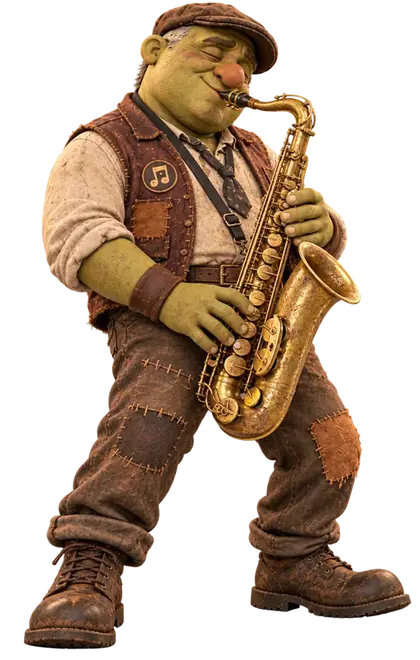
Leon "Last Call" Pritchard
SaxophoneResort duty: The Loose Bolt
"We're closing. Would you like another?"
Older, stocky, olive-green, in a flat cap, a brown vest and a loose tie, Leon plays the saxophone like a man who has decided that the evening is not over, no matter what the clock says.
Leon was hired to help close the bar. This was a mistake. He wipes down three tables, hears a good groove, picks up the saxophone, and extends the evening by forty minutes. His official closing checklist includes "one more song" in six separate places. His sax case sits beside the exit as evidence of intent.
He is, they say, always about to leave. He is always leaving after this song. It is the same thing he said four songs ago.

Ruby "Redline" Jackson
VocalsResort duty: Garage and parts counter
"Start with what happened. Then we'll get to what you told Willie."
Tall, coral-colored, with long rust-red cord twists, a patterned headband and a teal cropped jacket, Ruby sings backing vocals with the kind of voice that can answer a whole verse in three words.
Ruby runs the parts counter at the Garage. She can identify an engine fault from a guest making the noise with their mouth. She can also tell when they're leaving out the part where they hit something. She keeps a list titled Things Vern Has Borrowed. It occupies two notebooks and part of a wall.
She is, in her quiet way, the island's foremost detective. Where Willie tells the story, Ruby asks for the facts.

Mabel "Double Down" Price
Vocals and tambourineResort duty: Housekeeping supervisor
"You can explain it while you carry that."
Stocky and gold-colored, with short burgundy cord twists, a plum vest and a patterned scarf, Mabel sings with her whole body and plays the tambourine like a judge's gavel.
Mabel took charge of housekeeping after finding six band members using the same towel. She settles room disputes from the far end of the corridor and knows who took every missing pillow. Her tambourine summons the band, clears the breakfast room, and ends all discussion about late checkout.

Calvin "Low End" Booker
BassResort duty: Pool attendant
"Nobody's drowning. The groove's fine. We're having a good day."
Big, warm-brown, heavyset, with short dark twists and a gray goatee, Calvin plays a four-string amber bass, and he plays it low: long, stringy, reggae-tinged lines that sit underneath everything and hold it up like a dock holds up a boat. He is the most relaxed person on the island. He may be the most relaxed person anywhere.
Calvin keeps an eye on things from a lounger by the pool. The adjoining lounger holds his bass. A third holds supplies. He describes the fourth as emergency capacity. He tests the pool temperature with one foot and can identify a loose drain cover by playing a low E.
How They Fit Together
People who study bands (and on Braaptopia there are several, mostly at the bar) will tell you that every band is a machine, and that, like any machine, it has inputs and outputs and a certain amount of waste heat. The Go-Go Pedals are a very efficient machine, and it is worth seeing how.
Information enters through Willie, who receives every story first and improves it before passing it on. It goes next to Ruby, who removes the improvements, compares the result with what you told Willie, and files the difference. Meanwhile Vern removes parts from the island and Ruby records them, so that every object that leaves its place passes through her notebooks, and the notebooks grow at exactly the rate Vern borrows, like a tide gauge. Nina records everything else, then chops it into samples, which turns the band's only complete archive into a dance track and makes it permanently inadmissible. Otis converts loose things into shorter things. Mabel converts explanations into labor, so that any story you try to tell her is finished at about the moment the linen closet is. Calvin converts furniture into reserved furniture and holds the low end of the frequency range against all comers. And Leon converts every ending into a middle.
What goes in is chaos. What comes out is music, a reorganized linen closet, two notebooks and part of a wall, and nobody ever going home. It is, by any measure, a closed system, and like all closed systems on Braaptopia it runs continuously and cannot be turned off.
They do not agree on much. Willie and Ruby have disagreed about the same Thursday for years. Mabel and Leon have an arrangement about closing time that neither of them has ever described the same way twice. But when the lights come up on the stage behind the Loose Bolt and Otis counts it in, and Calvin drops the low end, and Vern and Nina start trading licks across the stage, they agree on everything, for about three and a half minutes at a time, which is longer than most families manage.
Chapter SevenHe Knows

There is a photograph of the band in the back hallway of the Purple Lodge, by the teal door they use to load gear, and most people walk past it three or four times before they see it properly.
All eight are gathered by the back entrance under the string lights, among the road cases. Willie is in the foreground with a coffee mug. And nobody is looking at the camera. Nobody is even looking in the same direction. Willie is looking at his mug. Mabel is looking at something off to the left that has clearly displeased her. Otis is waving at someone out of frame. Calvin is looking at the sky.
Except the guitarist.
Up in the top right, Vern is looking straight into the lens. Directly at you. With a small, knowing smirk, the expression of a man who knows something important that nobody else in the photograph knows, and has decided, on balance, to keep it.
And then you notice the sax player. Leon is not looking at the camera either. Leon is looking at Vern, with an expression that says, as plainly as if he'd said it aloud: you know, don't you?
The two of them are having an entire conversation without a word. Ruby has studied the photograph with a magnifying glass, and believes that Leon's expression has changed slightly over the years, and that whatever Vern knows, Leon is getting closer.
The Encounter
If you wander near the Maintenance Shed you may run into Vern, leaning on the wall, or sitting on a road case, or doing something to a piece of equipment that he is not authorized to do and that will, unfortunately, work. You will look at him. He will look at you.
HE KNOWS.
The guitarist looks directly at you. Smirks. Says nothing. That answers absolutely everything.
The guitarist knows.
What does he know? Nobody will tell you. Not Leon, who suspects. Not Ruby, who has a list of what Vern has borrowed but no list of what he knows, and finds this professionally intolerable. Not Willie, who will tell you a story about it that is almost certainly wrong and very enjoyable.
There is a school of thought (held mainly at the bar) that Vern knows nothing at all, and has simply worked out that a knowing look is the most efficient tool on the island. Consider the economics. A knowing look costs nothing. It requires no parts, so Ruby cannot log it. It cannot be borrowed, so it is never missing. It works on everyone, because everyone on Braaptopia has something they would prefer was not known, and a man who looks as though he knows it is treated with a certain courtesy. And it can never be disproved, because the only way to disprove it would be to ask him what he knows, and the moment you ask, you have confirmed that there is something to know. Vern, if this theory is right, has built a reputation for secret knowledge entirely out of other people's guilty consciences, at no cost to himself, and has been living on the interest for years.
The trouble with this theory is that it is exactly what a man who actually knew something would want you to believe. And so the island has settled, by long tradition, on not asking. Some mysteries improve with silence. This one has been improving for years.
The Pool After Closing
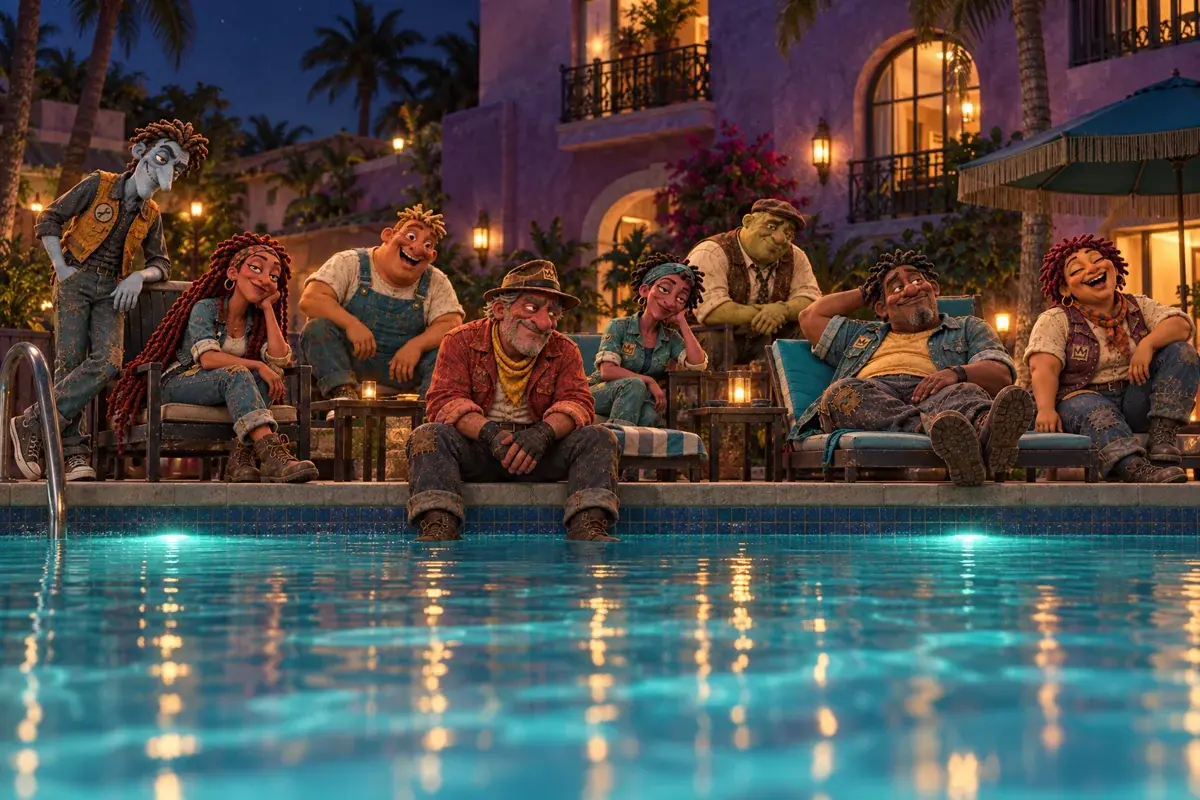
The pool at Braaptopia is OFFICIALLY CLOSED. There is a sign that says so. It is also STILL OCCUPIED. There is no sign that says so, because there does not need to be.
It is turquoise and warm, lit from below, with the Purple Lodge glowing behind and palms all round. At night the string lights come on, the band finishes its last set, and all eight of them drift over. Willie's boots end up in the water, somehow, with Willie's feet still in them. Nina and Ruby talk about something in low voices that stops when anyone comes near. Otis falls asleep. The band finished hours ago. Nobody has made any convincing attempt to leave.
The pool's rules are posted by the steps. There is one rule:
POOL RULES
NO FULL SENDS IN THE SHALLOW END.
And by the far loungers, you will find Calvin. He will lift one hand from his bass in a lazy wave. He has made certain arrangements.
RESERVED. ALL OF IT.
The bassist has reserved two loungers, one table, and the entire lower end of the frequency spectrum.
Furniture acquisition complete.
The arrangements bear examining, because they are a small masterpiece of reservation law. A lounger with a towel on it is reserved; this is understood at every pool in the world. Calvin's insight was that a lounger with a bass on it is reserved more firmly, because nobody moves another man's instrument. And a lounger with supplies on it is not merely reserved but in use, as storage. And a fourth lounger, kept empty, is not unclaimed, because it is emergency capacity, and nobody wants to be the person who used up the emergency capacity. So Calvin occupies one lounger and controls four, without ever having asked for anything, and every claim is one that any reasonable person would honor.
Mabel has tried, on several occasions, to reclaim the loungers for housekeeping. She arrives with a clipboard and the tambourine. Calvin plays a low E. The two of them regard each other for a while. Then Mabel goes back to the linen closet, the loungers remain reserved, and both of them, if asked, will tell you they won.
Just One More
On the patio of the Loose Bolt, under the string lights, after the kitchen has closed, you will usually find Leon, with his saxophone on his knee, about to go.
JUST ONE MORE
The sax player says he is leaving after this song. It is the same thing he said four songs ago.
One more song, allegedly.
Leon was hired to close the bar, and he takes the job seriously, which is the whole difficulty. Closing a bar is a procedure, and Leon follows a written checklist, and the checklist says one more song in six separate places. Each time Leon plays one more song, he is completing an item on the closing checklist. Completing checklist items is how closing progresses. Therefore every song Leon plays brings the bar measurably closer to being closed, and he can show you on the list exactly how much closer. The bar has, by Leon's figures, been ninety percent closed for about four years.
Mabel has asked him why a man whose job is to close the bar has never once closed it. Leon has explained that closing is a process, and that he is in it. The Loose Bolt's own motto, over the door, reads: One more song. Then we go. Probably. Leon maintains he wrote it, as a statement of intent, and that the important word is then.
Works When She Does It
In the Engineering Arcade you may find Nina in front of a piece of equipment with a red light blinking on it, and an engineer nearby looking at the red light with an expression of profound personal defeat. Nina reaches out, presses one finger on something, and the light goes green.
WORKS WHEN SHE DOES IT
The keyboardist fixes an intermittent fault with one finger. Engineering has asked her not to mention it.
Intermittent fault: caught.
Engineering's position on this is rigorous. A repair is something that appears in the manual. What Nina does does not appear in the manual. Therefore what Nina does is not a repair. The light going green, then, must have been a coincidence, and coincidences are logged, because Engineering logs everything. Engineering has now logged forty-one coincidences, all involving Nina, all in the first ten seconds, and has begun to suspect that the coincidences are the most reliable piece of equipment in the building. It has asked her not to mention this, partly from embarrassment, and partly in case mentioning it breaks them.
The Band Takes Over the Radio

The band has an ongoing relationship with the radio station that Radio Guy refers to, depending on his mood, as either a collaboration or an incident.
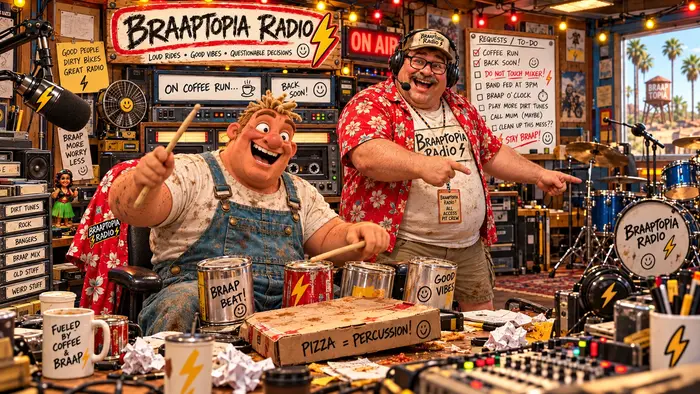
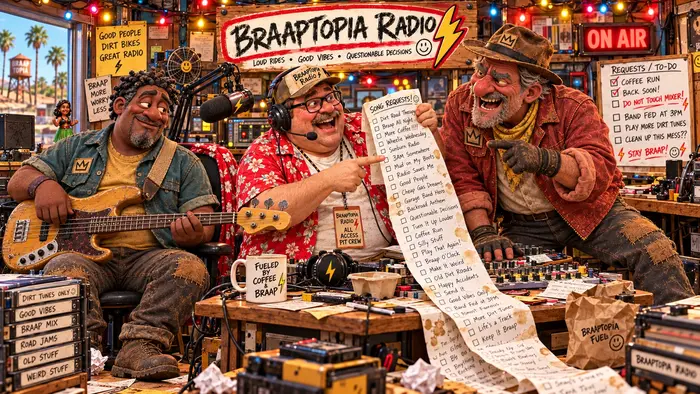
They are in the station's security footage constantly. Otis plays the drums on a pizza box. Willie belts into Radio Guy's microphone while Radio Guy is still talking into it, and the two of them carry on for some time, in harmony, about different things. Nina sits in the corner surrounded by a cascade of printed requests and samples them. Then the whole band is in the booth, and then the whole band is playing in the booth, and the security camera reports with mounting alarm that the junkyard house band has materialized and refuses to calm down, and then, a moment later, that the junkyard house band has escalated to full idiot rock opera.
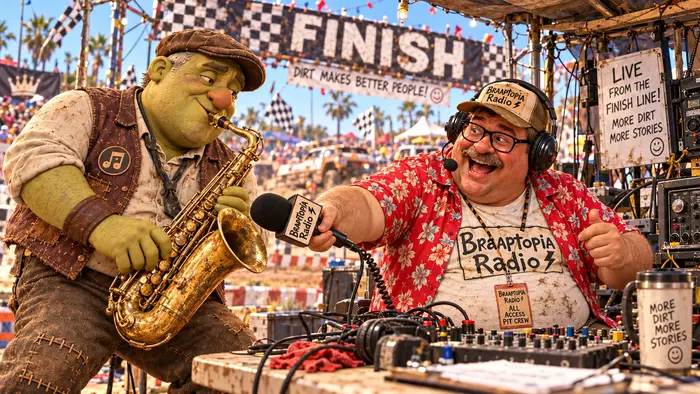
They turn up at the finish line under a banner reading DIRT MAKES BETTER PEOPLE, and at brunch behind a stack of pancakes taller than Mabel. And every so often they burst into the middle of Brain Melt, hijacking the station's signal for a few seconds of purple chaos before vanishing again.
Nobody authorized this. Radio Guy has given up trying to stop it, and his reasoning, when he finally laid it out on the air one evening, was hard to fault. He cannot keep the band out of the studio, because the studio door does not lock. He cannot fix the door, because the vice grips that would fix it are holding the refrigerator shut. He cannot take the vice grips off the refrigerator, because Steve's pudding cup is in there and it has seniority. So the band's access to the studio is, at bottom, guaranteed by a pudding cup belonging to a man who left eight months ago, and Radio Guy has decided he is not going to be the one who touches that. He has also admitted, privately, that the band is the best part of the show, and has asked that this not get back to them. It has. They know. They are insufferable about it.
Their Sound
Ask anyone on the island to describe the band's music and you will watch them struggle. It is not one thing. It is a lot of things that should not go together, at full volume, at once.
There is Texas in it, a swampy, low-slung, greasy machine-boogie guitar that sounds as if it was dug out of a junkyard and polished on the way to the stage. There is reggae, a deep, danceable bass-and-drum undercarriage that never sits still. There is hip-hop, because Nina's turntables are not a garnish; they scratch, constantly, cutting up vocal fragments and answering every guitar phrase with one of their own. There is a saxophone that refuses to go home, and Willie on top of all of it, stretching out that one word, BRAAAAAAAP, until it becomes a note. Some people call it Texas Reggae. Some call it nothing and just dance, and every so often the guitar and the turntables stop arguing and lock together, and the whole place lifts an inch off the ground.
Merch, Eventually
There is a merch table at the stage. It is empty. The merchandise is in the bus. Mabel has the inventory. Vern has the key. Each regards the situation as the other's responsibility, and the logic on both sides is unanswerable: an inventory without a key is only a list, and a key without an inventory is only a key, so neither of them has the merchandise, and both are right. Ruby has offered to hold both, which would solve it, and both of them have refused, on the same principle, which is that they would then have to agree on something.
INVENTORY: EVENTUALLY
The Live Show
Some evenings the radio pauses. The music on every speaker on the island stops, and in the silence you can hear the bay. The lights come up on the stage behind the Loose Bolt, and Willie Gasset and the Go-Go Pedals play a set.
Willie calls it a three-song set. Leon calls it the opening number. By the closing checklist, it is a significant step toward closing.
When it's over (if it is ever over) the station comes back on exactly where it left off, the island exhales, and somebody finds the kitchen keys.
ON AIR · BRAAPTOPIA RADIO
We have... okay, we have a situation in Studio A. The band is here. I didn't book the band. Nobody books the band. The band books itself.
Willie's got the microphone. That's my microphone. Willie, buddy, that's... okay, he's singing now. He's singing into my microphone. Otis is drumming on the pizza. That was lunch. That was everybody's lunch.
You know what, folks? This is what we do here. This is radio. Nina, take it away. Somebody get Calvin a chair. Somebody get Calvin two chairs.
Chapter EightFive Ways to Make a Decision

Every visitor to Braaptopia ends up at the Garage sooner or later, usually sooner, usually on purpose.
It is a long, low, weathered building, teal paint fading on old timber, with THE GARAGE blazing red over the doors and five open bays beneath. In each bay stands a machine, lit like a jewel in a case, gleaming the way only very fast, very dangerous things gleam. Over the bays, the Garage's motto has been touched up so many times by so many people that it is now mostly paint:
THE GARAGE
FIVE WAYS TO MAKE A DECISION
Over each bay, smaller: INSPECT · THEN FULL SEND. The order of those two words was the subject of a long discussion, which the word then won. Elsewhere on the wall a sign reads Traction sold separately, and another, in the hand of a mechanic who has given up waiting by the phone, Factory authorized. Factory unavailable for comment.
The five machines, left to right as you face the doors, are the ATV, the SXS, the Rally car in the place of honor at the center, the Trophy Truck, and the Dirt bike. Each belongs to a track. Each track belongs to an island. And each island waits out across the water, past one of the five great arches on the resort's shore.

You may inspect your ride. Step onto the showroom stage and the machine turns slowly on a platform in front of three tall walls of black-and-gold branding, with Radio Guy on the left wall, beaming, arm out, presenting it like the grand prize on a game show. You may spin it, look underneath, admire the welds and the zip ties. Most people do this once. We consider that enough. Some things deserve to be done properly even if they are only done once, which is also the island's position on its bridges.
The Rally Car
RALLY BRAAPIN'Sideways is how we get there.

The Rally car is a white off-road machine with the restless look of something that would rather be going sideways, and the Rally crew will explain why it should be, if you have twenty minutes, and they will take forty.
It goes like this. A corner is something you must see in order to drive through. A car pointed straight ahead sees the corner only through its windshield, which is a narrow view and mostly of the hood. A car turned sideways presents its whole side window to the corner, and so sees a great deal more of it. More information makes for better decisions. Therefore a car should approach every corner sideways. And since the next corner on a rally road is always arriving, a car that is sideways for this one is already partly set up for that one, and so the most efficient thing is never to straighten out at all. The crew has followed this argument to its end and now measures its corners not in degrees of road but in degrees of car.
The gate sign over the Rally arch reads SIDEWAYS IS A DIRECTION. The crew will add, with feeling, that the traction is sold separately, and this is not a joke. It was ordered, as an option, when the car was. It shipped separately, as the invoice said it would. And according to the tracking, which Ruby checks, it is sitting in the same warehouse as the band's replacement part, waiting for somebody to confirm whether the Rally car is a bus or a boat.
The Trophy Truck
TROPHY TRUCK BRAAPIN'More horsepower than good judgment.

There is a curious thing about the trophy trucks on Braaptopia: the cameras saw them first.
For a long time the island had four motorsport attractions, and none of them was a trophy truck. But people kept noticing, in the station's security footage, trophy trucks. Big ones. Parked in the paddock. Kicking up dust behind the finish banner. Nobody had ordered them. Nobody had built them a track.
A less careful island would have decided the cameras were wrong. Braaptopia reasoned it through. The cameras are the station's cameras. The station's archive is, by long policy, emotionally accurate: it records what the island feels to be true. The island evidently felt it had trophy trucks. Therefore it had trophy trucks, and the only thing missing was the trucks, which was a supply problem rather than a philosophical one. So it found one, and built it a home, and gave it an island, and the paperwork caught up with the footage, which on Braaptopia is the usual direction of travel.
It is a huge, planted, long-travel desert truck in white and red, with a V8 that slaps off the tunnel walls, enormous suspension, and a cupholder that rattles, built for landings that make the cupholder reconsider its career. Once you have the hang of it you will drift it through corners with a gentleness you would not believe of a thing that size. Its gate motto, which is also, if you think about it, the island's: MORE HORSEPOWER THAN GOOD JUDGMENT. Its crew's advice: If it rattles, let it ride.
The SXS
SXS BRAAPIN'Warranty void by default.

The side-by-side is a caged buggy built for jumps, ruts, tunnels, rocks, and plenty of opportunities to misunderstand the word shortcut, with a seat for a passenger who will, after one lap, be reviewing their life. Its gate sign reads TAKE THE QUESTIONABLE LINE. Its warranty is void the moment you look at it, and this was not always so. It was arrived at.
A warranty, as everybody knows, covers defects, and does not cover misuse. To pay a claim, then, somebody must first establish that the damage was not misuse, which takes an inspection, and an inspector, and witnesses. The Garage kept careful records, and the records showed three things. Every claim ever filed on the SXS had cost more to investigate than to fix. Every investigation had found misuse. And every warranty had been voided by lunch on its first day regardless. So the Garage asked itself the obvious question: if the warranty is certain to be void by lunch, why wait for lunch? Voiding it at delivery saved a morning. Voiding it at purchase saved the delivery. And since a sale begins the moment a customer looks at the vehicle with interest, the most efficient possible moment to void the warranty was that one, and so that is when it happens now, and the SXS has not had a valid warranty for any length of time that instruments can measure.
There is one exception. Ruby keeps a single warranty card in a sealed envelope in her desk, and has never opened it, on the principle that it is the only valid warranty on the island and she would like it to stay that way. She has never needed to use it. She regards this as proof that it works.
The ATV
ATV BRAAPIN'Four wheels. Many opinions.

The quad is lighter and more physical than the others: a red four-wheeler for rough trails, mud, snow, and the resort's increasingly ambitious civil engineering, which means timber crossovers, tunnels bored into the hills, and bridges certified under the 1.7-second rule. It has four wheels and, says its gate, many opinions, and anyone who has ridden it will tell you the opinions are mostly about where you should have put your weight. Its rider's advice, painted on the arch: Keep the greasy side down.
The Dirt Bike
DIRT BRAAPIN'Pin it now. Explain it tomorrow.

The motocross bike is gold and orange, light and violent, built for berms and jumps and roost (the spray of dirt a rear tire throws when it is being asked to do too much and is agreeing anyway). Two wheels, a starting gate, jumps stacked one after another, and the eternal question of the motocross rider: how do I get this thing pointed somewhere useful before the ground arrives? Its gate reads DROP THE GATE. Its creed, quoted all over the island by people who will never ride a dirt bike: Pin it now. Explain it tomorrow.
A note on terms: in the Rally car, the Trophy Truck and the SXS you are a driver; on the ATV and the dirt bike you are a rider. This is enforced with remarkable firmness by people who enforce almost nothing else, and if you get it wrong at the Loose Bolt, somebody will correct you before your drink arrives.
Registration

Before every race, on every island, you will find Radio Guy at a folding table beside his pickup, in a dusty paddock among the canopies and coolers, with a clipboard, a stack of registration forms, and a pen that works on the second try. He is thrilled for you whatever you are entering. And he will ask you to fill in your class.
You will look at the form. The only box under CLASS says Yes. And here is how it got that way, because, like everything at that table, it was done by the book.
A racing class exists to group similar vehicles, so that like competes with like and the contest is fair. Radio Guy, as registrar, applied this rule strictly. He went around the paddock and compared the vehicles, and found that no two were similar. Nothing on Braaptopia is built twice the same way; every machine has had something zip-tied to it that no other machine has. So each vehicle had to be placed in a class of its own. A class of one has one entrant. That entrant wins it. And so, by the time the gate drops, every competitor on Braaptopia is already a class champion, and the race that follows is, strictly speaking, a lap of honor, though most people drive it as if it weren't.
The serious crews have objected to this. Radio Guy has shown them the form. They have looked at their own vehicles, and at each other's, and been unable to name two that are alike, and gone away. Visitors who finish last are surprised to be congratulated, and more surprised to discover they deserved it.
Then the pit crew offers encouragement on a pit board, in the tone of people who love you and have seen you drive:
YOU'VE GOT THIS. PROBABLY. MAYBE. ✦ COURAGE IS JUST BAD JUDGMENT WITH GOOD MUSIC. ✦ IF IT FEELS WRONG YOU'RE PROBABLY GOING FAST ENOUGH. ✦ FEAR IS FOR PEOPLE WITH BETTER INSURANCE. ✦ RIDE LIKE THE BURRITO IS ALREADY PAID FOR. ✦ SEND IT LIKE NOBODY'S WATCHING (THEY ARE). ✦ GO MAKE THE TRACK REGRET EXISTING. ✦ SOMEWHERE A GOAT IS TAKING NOTES. ✦ WE'RE FILMING THIS FOR INSURANCE, NOT INSTAGRAM. ✦ THE THROTTLE KNOWS BEST, PROBABLY. ✦ CONFIDENCE: MAXED. JUDGMENT: MISSING.
And then you are at the line, and somebody drops the gate. At the first big jump, if you glance down, you will see him again, low and to one side, mostly off the racing line, microphone up, staring at your machine as it sails over his head with the face of a man who cannot believe what he is seeing and is going to tell absolutely everyone, starting now, live.
Decision Pass
The tracks have names: High Rocks, High Strung, Mountainside View, the Over-Under, Swamp Weave. And Decision Pass, so called, everyone agrees, because that is where you make your decision.
Nobody agrees on what the decision is. Ruby says it is whether to brake. Willie says it is whether to keep going in life generally. Radio Guy says there is no decision at Decision Pass at all, and he can prove it. The decision to race, he points out, was made at registration, in writing, and he has the form. Everything that follows is simply that decision being carried out. To brake at Decision Pass would be to reopen a matter already closed, which is poor procedure, and Radio Guy, whatever else may be said of him, will not stand for poor procedure. Decision Pass, in his view, is where you find out what you decided. It has a very good view.
InterludeThe Ballad of the Full Send
There is a song they play on Braaptopia Radio called "Full Send," and it tells a story. Whether the story happened is a question nobody on the island cares to settle. What follows is the story as the song tells it, verse by verse, pieced together from the lyrics, the station's camera archive, and Radio Guy's own account, which changes every time he gives it and gets slightly better each time.
It begins at golden hour, over a sprawling motorsport facility: trophy trucks, rally cars, side-by-sides, quads, dirt bikes, a hangar the size of a cathedral. It looks like the opening of a manufacturer's commercial, the kind that costs more than the cars. Welcome to Braaptopia, the song begins, and the camera swoops down, and down, and down, past all of it, until it finds one man standing beside a vicious, beautiful, deeply questionable machine. It is Radio Guy. He is holding his clipboard upside down, with great confidence. His badge reads:
BRAAPTOPIA VEHICLE DEVELOPMENT
ACTING DIRECTOR
Nobody else showed up
He opens the garage door. He pops the hood. He inspects the engine with enormous seriousness, and the closer you look the more horrifying the engineering becomes: a gigantic motor, hoses that were introduced to each other recently, improvised brackets, zip ties holding things to other things that are themselves held on with zip ties. His badge has changed:
FACTORY AUTHORIZED TECHNICIAN
Factory unavailable for comment
Toolbox full of zip ties and alibis, sings the song, and he goes rummaging through drawers of duct tape and loose hardware. Cupholder packed with loose change and regret: bolts, washers, pennies, and a sense of loss. He searches. He searches frantically. And then, on the line ten mil from my socket set, he holds it up to the camera, the missing ten-millimeter socket, triumphant, radiant, like an explorer lifting a lost relic from a temple floor while the music swells.
He climbs into the cockpit and turns the key. Every warning light on the dashboard comes on at once, and every buzzer goes off together, a whole choir of alarms. He studies the display. He looks at the camera. He grins.
QUALITY CONTROL
Passed
Every light red, the song goes, but it's green to me. And he slams it into gear.
Out on the desert test roads he lets it rip. More horsepower than good judgment: tire smoke. If it rattles, let it ride: something on the car shakes in a way that something on a car should not shake. Wind her up hot: the gauges climb. And then, on the chorus, FULL SEND, the car flies off a crest, lands a little sideways, keeps going, and Radio Guy gives a thumbs-up to nobody in particular.
He arrives at the race. The real racers are there, with their serious crews and serious machines, and they look at him the way a cat looks at a bath. He takes his clipboard to the registration table.
COMPETITOR
CLASS: Yes
Somebody reluctantly points him toward the track. He beams.
We bought the horsepower, goes the second verse, the traction, however, is sold separately. He launches in an enormous cloud of wheelspin, moving in a direction best described as somewhere between forward and definitely-not-forward. No hesitation, no competence, the song goes on, and he slides through corners with total confidence, stayin' outta the fence by a margin that is frankly an insult to the fence. One hand on the wheel. The other reaching over to turn up the radio.
PROFESSIONAL DRIVER
Professional-ish
And then, around him, Braaptopia happens. The trophy trucks arrive in a rooster tail of dust. A rally car slides past. A side-by-side bounces over a crossing. A quad, then a dirt bike, in the air. Nobody organized any of this. Braaptopia is simply becoming Braaptopia around him, the way weather becomes weather.
Crank up the radio, sings the song, and he turns the knob, and suddenly he is in the studio, still covered in dirt, behind the board, headset on, offering the world advice you definitely should not follow.
ON-AIR TALENT
Talent disputed
Back outside. The car has stopped. The hood is open. Smoke is rising. Something smells hot, sings the song. He sniffs. He looks at the camera. He looks at the engine.
WARRANTY DEPARTMENT
Claim denied
A pause. The smoke keeps rising. He considers it, as a judge considers an appeal. We're just gonna ignore that, sings the song. What choice you got? He closes the hood. Turn it up. He cranks the radio. Take the hard line. He gets in. Pin it. The engine roars. Play dirtier. And he launches straight through the biggest mud puddle on the island and plasters the camera.
All of Braaptopia is going now, everywhere at once, every island, every machine.
EVENT SAFETY DIRECTOR
Going great
Then the music drops away. The bridge. It goes quiet. And Radio Guy is sitting at the foot of the biggest, most unreasonable ramp anyone has ever seen. A crew member stands beside it, pointing at it and shaking his head with his whole body. Radio Guy studies the ramp. He studies the car. He studies the camera. He smiles.
RISK ASSESSMENT
Approved
Pin it now. Explain it tomorrow. For the first and only time in the song he takes off the headset and puts on a racing helmet. He tightens the harness. He grips the wheel. The tachometer climbs. He sidesteps the clutch. The car launches at the ramp, faster and faster and faster…
FULL SEND.
The car is airborne over all of Braaptopia, impossibly high, the whole island spread out below, and Radio Guy is laughing, or screaming, or doing the thing that is both. It lands in a tremendous cloud of dust. And out of the dust it comes: battered, steaming, short several pieces, still running.
Sunset. The car is crooked and smoking. Parts are scattered across the dirt. Radio Guy climbs out, takes off the helmet, and puts the headset back on, because he is still, technically, on the air.
POST-RACE INSPECTOR
No problems found
No plan, sings the song, as the camera pulls back on the wreckage. Full send, and he pats the car fondly on the roof, and a part falls off. No problems, and he nudges the fallen part under the car with his boot, where it will not trouble anyone.
He walks toward the camera with the sun going down behind him, the steaming machine at his back and the other machines of Braaptopia passing in the distance. He grins. He gives a thumbs-up. His badge reads:
BRAAPTOPIA RADIO
PRESS
Allegedly
Braaptopia dot com, the song ends.
And then, of course, there is one more lap.
Chapter NineEverything Flight-Wise Goes Through WTF

Down by the water, past the entry gate, on a concrete slab that runs out over the bay, is the Flight Base. There is a big octagonal helipad with an H in the middle and landing beacons around the edge. There is a seaplane dock, built sturdy enough to be seen from the air, after an earlier, more modest dock proved invisible to every pilot who looked for it. There is a building with a huge mural on its side: a pair of chicken drumsticks and the words BRAAPTOPIA HOT WINGS DELIVERY.
And leaning on a fence post by the pad, with a coffee mug in one hand and a clipboard under his arm, is a lean, weathered, silver-haired man in a canvas jacket, boots and jeans, with the easy slouch of someone who has been flying things for a very long time and stopped being impressed by any of them somewhere in the previous century.
His name is Waylon "Torqued" Ferguson. Everybody calls him by his callsign, which is made of his initials, and he will explain it to you himself, right after the radio check, because he has been explaining it for years and has never once tired of the look on people's faces:
"Everything flight-wise around here goes through WTF. That's Waylon 'Torqued' Ferguson."
How Waylon Came to Braaptopia
Waylon's story is the same as everybody's, only faster. Years ago, passing through, he set down to top off the tanks. Somebody offered him a cup of coffee. And before it had cooled enough to drink, somebody else handed him the keys to the airfield, on the reasoning that he was a pilot, and they had an airfield, and he was standing on it.
He now handles dispatch, maintenance, and all explanations involving the word probably, which is most explanations. The seaplane dock's construction date is on his clipboard in pencil, which he considers the only honest way to record a construction date. And he has a saying:
"If it flies, I can land it. If it floats, we can discuss it."
Webb, who handles the things that float, regards this as a territorial statement, which it is. Anything with wings is Waylon's. Anything with a hull is Webb's. Anything with both, or neither, or a jet engine where neither man would have put one, is discussed at the Loose Bolt, at length.
Which Bird
You may fly at Braaptopia. You do not need to know how. In fact, Waylon would prefer you didn't, and his reasons are sound.
A pilot who understands flight dynamics, he will tell you, understands everything that can go wrong. A pilot who understands everything that can go wrong grips the controls. And gripping the controls is, in his long experience, the single most common cause of things going wrong. It follows that the safest pilot is the one who knows the least, and Waylon, who has forty years of understanding and cannot get rid of any of it, has concluded that he is the most dangerous pilot on the island, which is why he mostly does dispatch. He does not want you to understand flight. He wants you to go somewhere. So he asks only one question:
"Which bird do you want to fly?"
And then he finds you a job for it. There are always more flights than pilots, which Waylon regards as the natural state of the universe.
The Skycrane is the big one: a massive yellow-and-green heavy-lift helicopter with a whupp-whupp-whupp you feel in your chest before you hear it. It barely fits its own pad, which Waylon says is how a pad should fit, like a good boot. It hauls containers of ATVs and rally cars out to the islands, and it services the tower, endlessly, carrying new antenna bays out and broken ones back. The supplies are essential, says the dispatch board. The paperwork is optimistic.
The Medical Helicopter, red and white, with a howl like the Trophy Truck, flies to the outer islands, lands wherever the colored smoke flares say, and makes a fast run to the hospital on the mainland, which has its pad on the roof. Nobody here will tell you who got hurt or how. It is enough to know somebody needed a ride, and got one.
The Island Hopper is the fast one, sleek and high-revving, which can, in Waylon's estimation, rock and roll. It carries parts and passengers between the airport, the hotels, the Office Building on the mainland and the islands, and somewhere in most of its runs is a CEO being collected for a little Executive Playtime. Nobody knows who the CEO is. The CEO always has a very nice time, and has never once been asked to sign anything, which is perhaps why.
The Floatplane is everyone's favorite, with the deep, thumpy, radial-sounding drone you hear over old lake towns in the morning. It runs shuttles and freight to the seaplane bases on the islands, the mainland and Far Harbor. It is not a flight simulator and has no wish to be one, but people who know seaplanes have been surprised by how real its landings feel. Come in too steep and it noses in with a tremendous kersplash. Come in right and it settles onto the water like a duck that has done this before.
And then there is Waylon's Special Project, parked at the end of the dock under a tarp, which he refers to variously as the special sauce and these wings are hot. It is a floatplane. Technically. But somebody (Waylon will not say who; Webb, asked, says only that it is not his, with a stress that suggests he knows whose) has done something to it, and now it goes faster than any floatplane has business going: about as hot as it gets and still controllable, in the account of the one visitor who has flown it in a full race. That visitor's review, in full: Wheeeee!
On certain days there are races in the sky over the bay, through great glowing numbered gates hung at every height: the Roundabout Trainer, the Mobius Figure Eight, the Longwave Slalom, Sky Spaghetti, the Cross-Bay Burner, and the WTF Grand Tour, which goes everywhere and apologizes for none of it. Nobody has yet landed the Special Project in the water during a race. Several people have come close, and are still talking about it.
Braaptopia Hot Wings Delivery
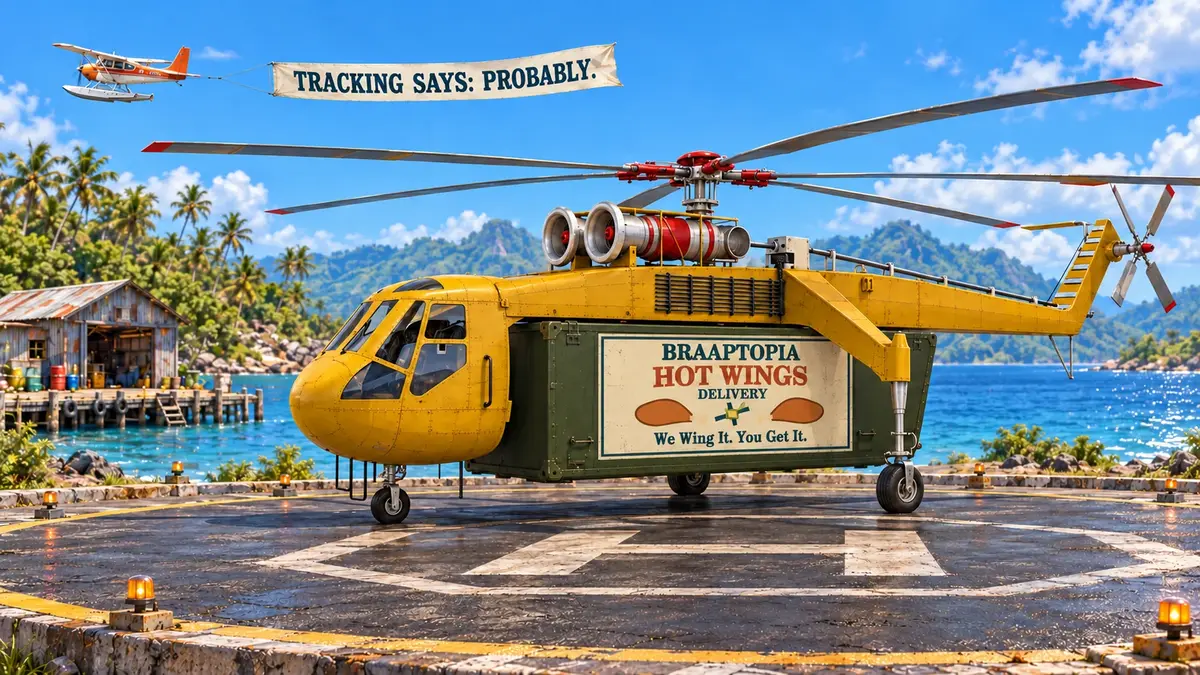
Waylon's air freight operation needed a name. One proposal was an acronym that cannot be printed in a family publication, though it was accurate. Then somebody said wings, and somebody said hot, and a logo was drawn: two chicken drumsticks flanking a little wrench, on a tan stamp, like the label on a takeout bag.
BRAAPTOPIA HOT WINGS DELIVERY
WE WING IT. YOU GET IT.
CARGO MAY SHIFT. RANCH SOLD SEPARATELY.
It is an air freight company. It has never delivered chicken. And what followed is a small masterpiece of corporate communications, every step of it correct.
People began phoning to order wings. The obvious remedy was to tell them, clearly, that Hot Wings does not deliver chicken. So a sign went up at the depot: We're everything BUT chicken. A notice went on the van's dashboard: Please stop asking the driver for ranch. And Radio Guy was asked to make the announcement on the air, every hour. Each of these was a sensible measure, and each of them contained the word chicken, or ranch, or both. Within a season the word chicken appeared in more places on Braaptopia than in any restaurant in the region, every one of them a denial, and the calls went up. Waylon has studied the call log and found that wing orders peak about ten minutes after each on-air disclaimer, like clockwork. He has worked out that stopping the disclaimers would reduce the calls. He has also worked out that it would allow people to go on believing Hot Wings delivers chicken, which it does not, and which somebody has to keep telling them. So the disclaimers continue, and the calls continue, and Hot Wings is now the most chicken-associated brand on the bay, having achieved this entirely by denial.
WTF: Cargo run. Not a lunch run. Please stop asking the driver for ranch.
WTF: Hot Wings Delivery. We wing it. You get it. Usually in that order.
WTF: The van is insured against hunger. Everything else is under discussion.
When the job is done: Back at the dock. Transfer the cargo, not the crumbs. Please leave the sauce packets ashore.
What it actually carries, by the planeload, is zip ties, duct tape, vice grips and ten-millimeter sockets. In all the island's logistics nobody ever discusses food. It is not that nobody eats. It is that when Braaptopia thinks about supply, it thinks about zip ties first, and by the time it gets around to lunch, it is lunch, and somebody has already gone. The one company on the island named after food is the one company that never carries any. Waylon's position is that this is not irony, it is branding. Ruby's position is that it is both, and that she would like a sandwich.
The Van
At the docks on the mainland and the far waterfront, a battered retro van, hand-painted with the Hot Wings logo, carries cargo the last few miles inland. Its top speed is forty-two miles per hour. Not forty. Not forty-five. Forty-two. Nobody will tell you why, and the people who know have a way of smiling when you ask that suggests the reason is excellent and that you will not be getting it. A sign by the dock reminds you, before you get ideas: The van is not amphibious. This sign went up after someone got ideas.
Braaptopia Airspace Control
With a Skycrane, an air ambulance, an Island Hopper, a fleet of floatplanes, a banner plane and Waylon's Special Project all sharing the sky over one bay, you might expect a sophisticated system of air traffic control.
There is a system. When two aircraft find themselves at nearly the same height in nearly the same place, they are moved slightly apart vertically, and the arrangement is logged as vertical separation: technically yes. The reasoning is hard to fault. A collision requires two aircraft to be in the same place at the same time. Braaptopia's aircraft are almost never in exactly the same place at exactly the same time, because the bay is large and the pilots are good. Therefore the collision rate is very low. Therefore the system is working. Therefore it must not be changed, since changing a working system is the leading cause of systems that don't. Its whole safety philosophy, as summarized by someone close to the operation, comes to four words:
"But did you die?"
The banner plane has been seen trailing a banner that reads, simply: TRACKING SAYS: PROBABLY.
ON AIR · BRAAPTOPIA RADIO
Traffic and weather together on the nines. Traffic first. We've got the Skycrane over the tower again, bringing the tower another antenna. I don't know where they're going to put it. I don't think they know where they're going to put it. Island Hopper's crossing the bay eastbound, the banner plane's westbound, and those two are, I'm told, vertically separated. Technically.
Hot Wings reminds you, once again, that they do not deliver chicken. They want me to say that. They have asked me to say that on the air every hour. They are getting a lot of calls.
Weather: dry enough for dust, wet enough for excuses. Here's one for everybody up in the air today.
Chapter TenYou Know What Bridges Would've Cost?
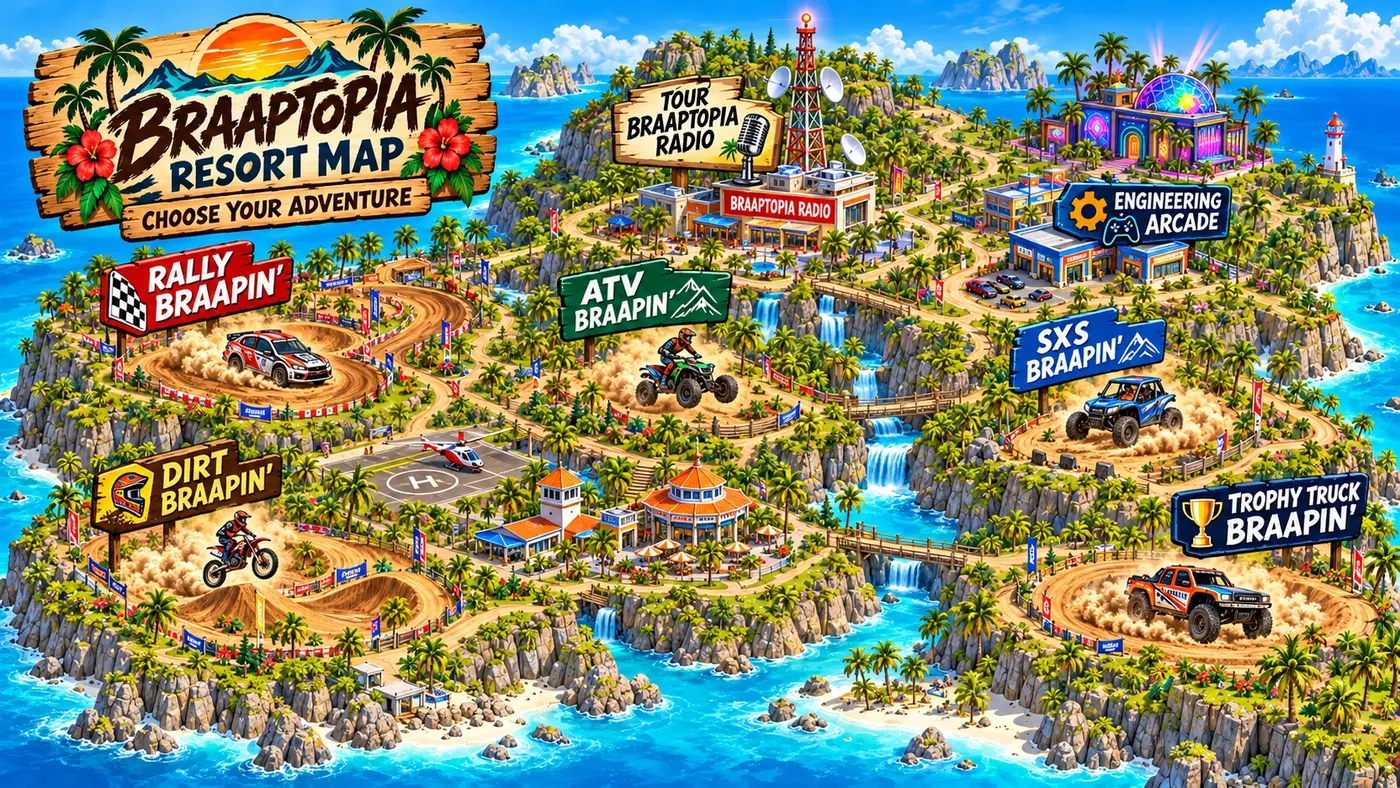
Braaptopia sits out in the middle of a wide bay, and it is worth stopping to look at where everything is, because the geography explains a great deal, and what it does not explain, it at least makes look intentional.
On one side is the mainland, with its city, marinas, hospital, airport and the Transmitter Supply depot where the tower's antennas go to be mended. On the other side, farther off, is Far Harbor. Braaptopia lies between them, well out in the water, like a man who sat down in the middle of a dance floor and refused to explain himself.
And fanned out around it, like the petals of a flower, are the five outer islands, each holding the tracks of one of the five machines in the Garage, each lying out past the arch of the same name, so that when you stand under the Rally arch you are looking at Rally Island. Their peaks are modest, typically about a hundred and thirty feet above the water, but when you are flying low over them in a heavy aircraft a hundred and thirty feet is all the mountain anybody needs.
No Bridges
You will notice it eventually: there are no bridges. Not between the resort and the outer islands, not between the islands and the mainland. You go by boat, or by helicopter, or by floatplane.
There used to be bridges. Long ones, miles long. Oddly, you could not drive on them, but you could fly under them, and pilots did, with great enthusiasm, because a bridge you cannot drive on is really just a very long gate. They got in the way of the races. Eventually it was decided they had to go, and they went.
People still ask whether it wouldn't be easier with bridges. And the people of Braaptopia, who own a heavy-lift helicopter, an air ambulance, an Island Hopper, a fleet of seaplanes, a jet-powered yacht and a truck that may or may not fly, will look at you with real puzzlement and say:
"You know what bridges would've cost?"
The beauty of this answer is that it is entirely correct, and that it requires you not to add up anything else. A bridge miles long would cost a fortune. The island does not have a fortune. Therefore no bridge. That the island has instead acquired an air force and a navy, each of which also cost a fortune, does not enter into it, because those were not bridges. Each decision was made on its own merits, by different people, on different days, and each was sound. It is only when you stand on the shore and add them all up that something seems off, and nobody on Braaptopia has ever stood on the shore and added them all up, because there is always something more interesting to do.
Ask about a bridge to the mainland and the answer is shorter: "Bridge to the mainland? Nope. We don't need that. We've got wings."
The bridges inside the tracks (the timber crossovers, the steel spans over the rivers) are still there. They were certified under the 1.7-second rule, and they are not going anywhere.
The Bay Got Bigger
Once the bridges were gone, the bay got bigger. The islands are exactly the size they always were. It is the space between them that grew. The water lanes are wider now, the flights longer, and the boat races have room to open up.
The best explanation anyone has offered comes, unexpectedly, from Ruby, who approached it as a parts question. A bridge, she points out, is among other things a very long fastener: it holds two pieces of land exactly one bridge-length apart, and it does this every day, without being asked. Take the bridge away and nothing is holding the distance anymore. And distance, like a banner slogan or a band's set, will tend to grow when nobody is holding it. So it grew, by exactly as much as it pleased, and the only real surprise, in Ruby's view, is that anyone expected otherwise.
Webb, pressed on the matter, said that islands don't move, and then, after a while, that these ones had. Waylon said the flights were longer and he wasn't complaining. Radio Guy said it was a great day for the bay. It was, by every account, an improvement.
Where Does It All Come From?
You will notice the contradiction if you stay more than a day. Braaptopia is held together with zip ties, its station cannot get a sponsor, and its Maintenance Shed keeps the accounts on a clipboard. And yet it has a heavy-lift helicopter, a fleet of seaplanes, a jet-powered boat, two enormous hotels, an eleven-hundred-foot tower and a high-tech ghost-hunting simulator. Ask anyone where it all came from, and they will answer with a perfectly straight face:
"Where do you get all this infrastructure?"
"Internet."
And then they will look at you, waiting to see if you have a better explanation. Nobody ever has.
Chapter ElevenWater Transportation Was Supposed to Be the Safer Option

On the north shore, by the purple registration building, at the end of a dock, sits the Braaptopia Express.
It is described officially as a performance yacht with a jet booster. Some say it looks like a hovercraft, some a racing catamaran. It has two long narrow hulls in a blaze of rainbow colors, a low cockpit, fins at the back, and a jet engine. When it runs, flame comes out the back, more or less flame depending on how hard the person at the controls is leaning on it, and they are usually leaning on it.
It is the island shuttle.
How Braaptopia Acquired a Jet Boat
Somebody was sent to find a boat. A reasonable boat, to ferry guests to the track islands now that there were no bridges. Jet skis, perhaps. A fast powerboat. Something sensible.
And while looking, they came across this. It was not a jet ski. It was not a powerboat. It was something else, and it was available, and nobody else seemed to be using it. The decision that followed has been reconstructed many times at the Loose Bolt, and always comes out the same:
What is it? Nobody knows. Is it available? Apparently. Is it a boat? It floats. Does it fit? It fits. And on Braaptopia, the rule for a thing that fits is well established: if it fits, it ships.
It was registered as a performance yacht with a jet booster because… well, because. Waylon looked at the jet and said it was his. Webb looked at the hulls and said it was his. It was eventually settled, over most of an evening, that the Express is a boat that has so far declined to fly, and is therefore Webb's, and that Waylon may have it back if it ever leaves the water for more than a few seconds, which, at the speeds involved, is not entirely out of the question.
Its day job is to shuttle guests from the north dock to the five track islands. When there is nobody to shuttle, of course, somebody inevitably points it at open water and calls it a race program.
The Ride
At low speed the Express hums along on electric power, nosing gently in and out of the docks. Its readouts say DOCKED, then ELECTRIC, and everything is calm and civilized and you begin to relax.
Then you engage JET.
The flame comes out the back. The boat lifts. The shoreline becomes a smear. The water, which looked flat from the dock, turns out to have opinions, and to have been saving them. The readout goes COAST, then ROUGH WATER, then JET again. A full lap of the whole world (resort, islands, mainland, Far Harbor and back) takes not much longer than a song.
And here is the joke every Braaptopian enjoys at the expense of every newcomer. Some guests arrive afraid of flying. They would prefer to travel by water, which is surely the gentler, safer, more dignified option. They board the Express. And when they step off, white-knuckled, soaked, hair standing straight up, they all say some version of what the resort's own description of the Express says for them:
Water transportation was supposed to be the safer option.
Flying suddenly seems perfectly reasonable.
Which makes the Express, by a wide margin, the most effective piece of aviation marketing on the bay. Helicopter bookings always rise the day after a new guest rides it. Waylon has noticed this and never mentioned it to Webb. Webb has noticed it and never mentioned it to Waylon. Both consider the arrangement to be working.
The Races
When the Express is not shuttling, it races. Every race is a round of the championship, and every round is an event: twenty of them, each sponsored by a business whose existence nobody can verify. The courses have no names. Nobody misses them. You are not racing Course Four in reverse; you are racing the Rod, Reel & Regret Nationals, and that is all anybody remembers afterward.
The question of whether the sponsors exist was raised once, and settled by Radio Guy in about a minute. A sponsor's job, he pointed out, is to have its name on the banner. These names are on the banners. So the sponsors are doing their jobs, and doing them well. Whether they also exist is a separate question, and not one that sponsorship requires. None of them has ever paid. The island has noted that this makes them identical in every respect to the station's other sponsors, and has stopped asking.
The courses are tall numbered gates rising out of the bay, and the water remembers. Every boat leaves a wake, the wakes pile up, and by the last lap five jet engines have churned the bay into a washboard.
The Rivals
There are four of them, and you will get to know them well.
Mitch HammerdownUsually out front. The man to beat. Nobody has ever seen him lift.
Ricky PropburnRight on Mitch's tail, every single round, close enough to read his transom.
Darrell SidewaysSomewhere in the middle of the pack, and true to his name, rarely pointed exactly where he is going.
Jimmy DockrashBringing up the rear. His name is less a nickname than a description.
Jimmy has given a good deal of thought to which came first. He maintains he was a perfectly sound driver before the name, and that since being registered under it the docks have simply started finding him, as if they had read the paperwork. The other three say he was hitting docks long before. Nobody can settle it, because the registration form is the only record, and Radio Guy, who filled it in, says Jimmy wrote the name himself, and Jimmy says Radio Guy handed him the pen already pointed that way.
The Championship
Before each round, Radio Guy appears on the intro card, beaming, to introduce the event. They are some of the finest work he has ever done, and he knows it.
THE GUPPY AMATEUR SHOPS REGIONAL "Professional-grade enthusiasm, aggressively amateur decision-making, and somebody actually found trophies. We're going racing."
THE BAIT BUCKET PRO-AM "Check your fuel, keep the wet side down, and try not to hook anything expensive."
THE FIELD & SCREAM OUTDOORS OPEN "Outdoor recreation gets louder, faster, and considerably less relaxing from here."
THE PRE-OWNED AFTERBURNER OUTLET PRO-AM "Every component has been inspected by somebody who knew a guy. Good enough for me."
THE BIG FISH LITTLE STORE INVITATIONAL "Tiny sponsorship budget, enormous motors, and plenty of questionable judgment. Let's light 'em up."
THE EAR PLUGS R US THUNDER CUP "Ear plugs in, loose objects secured, questionable decisions confirmed."
THE OUTDOOR MEGA MART MARINE OPEN "Boats, horsepower, outdoor excitement, and enough parking to lose your truck for three days."
THE ROD, REEL & REGRET NATIONALS "Cast carefully, drive irresponsibly, and try not to create another Thanksgiving story."
THE MEGA LURE OUTDOOR CUP "Oversized machinery, polished aluminum, and enough horsepower to confuse migrating birds."
THE LOWEST BIDDER FUEL SYSTEMS PRO-AM "Everything passed inspection, provided nobody asks what kind of inspection."
THE HULL & VOID WARRANTY CLASSIC "If you still have factory coverage, give it about thirty seconds."
THE WHAT DOES THIS LEVER DO PRO-AM "Experimenting with unfamiliar controls during competition is strongly discouraged, so naturally somebody will."
THE TECHNICALLY A BOAT NATIONALS "The word 'technically' is doing a whole lot of work around here."
THE SIGN THIS WAIVER CLASSIC "Initial every page, ignore how many pages there are, and let's get this thing moving."
THE FLAMEOUT FRIDAY NIGHT SHOOTOUT "It's loud, it's late, and anything still running at the finish had a pretty good night."
THE UNSCHEDULED FLIGHTS INVITATIONAL "Watercraft occasionally explore alternative transportation around here. Landing quality is not part of the scoring."
BOB'S BARGAIN EJECTION SEATS INVITATIONAL "Bob says all sales are final, installation instructions are somewhere, and frankly that sounds reassuring enough."
THE INSURANCE ADJUSTER'S NIGHTMARE NATIONALS "Somewhere, a claims representative just woke up sweating and doesn't know why."
THE ZIP TIE DEPOT NATIONALS "Get your Perma Bond Tape ready and find your 10 millimeter sockets. Structural integrity is mostly a state of mind."
THE BRAAPTOPIA GRAND PRIX "Twenty rounds of bad judgment led us here. No excuses now. Try to look professional."






Who is Bob? Nobody knows. His ejection seats are, by every account, a bargain, and the only complaint on record concerns the installation instructions, which are somewhere.
Between races the Express still runs its shuttle, and freight too, handing off to the Hot Wings van at forty-two miles an hour, exactly, like everybody else. Its dispatch is handled by Webb, the island's Head of Maintenance and resident boat man. If anyone knows why the Express runs, it is Webb.
If anyone knows why it leaks, that is also Webb, and he would prefer you didn't bring it up.
Chapter TwelveThe Shed, and the Internet of Questionable Solutions

Every island needs somebody who knows how things actually work. On Braaptopia, that somebody is Webb Whitley, and he would like you to know that he did not ask for it.
You will find him at the Maintenance Shed, usually near the toolbox nobody is allowed to reorganize. He is older, and heavier than he used to be, but it is obvious at a glance that he was once very, very strong: thick forearms, cap pulled low, a rag in his back pocket and a wrench in his hand. In his younger days he was the one they asked to lift the heavy end. He still could, probably. He would rather you did.
Webb is Head of Maintenance, boat man, marina chief and keeper of the Shed. He is not a people person. He does not do small talk, and if you ask how his day is going he will look at you for a long moment as if you have asked him to explain the color blue, and then he will tell you what is leaking. The Shed's own description of him:
Social finesse is not a listed qualification. Getting the thing running is.
And the Express dispatch board's:
Boat guy. Head of Maintenance. If it floats, runs, rattles, leaks, or somebody bolted a jet engine to it, Webb probably knows why.
The island depends on the difference between Webb and Radio Guy. Radio Guy is the man who looks at a terrible idea and is delighted. Webb is the man who looks at the result and knows exactly why it is leaking. Between them, every bad idea on Braaptopia gets both an enthusiastic launch and a competent repair, usually on the same afternoon, and the island has found this a better arrangement than having no bad ideas at all, which was tried once, briefly, and was very quiet.
The Shed
The Maintenance Shed was for a time signposted The place where all questionable ideas begin, until somebody pointed out that it was also where they ended up, and the sign was replaced with something more accurate:
VEHICLE DEVELOPMENT, ALLEGEDLY.
MAINTENANCE · IF IT RATTLES, LET IT RIDE
The band's bus is parked behind it, mown around. The missing ten-millimeter socket is on its workbench, in plain sight, where nobody will admit to having looked. The guitarist is often nearby, knowing things.
When anything on the island needs fixing, moving, floating, flying, recovering, bypassing, or making considerably more interesting, it ends up here. The Shed is where problems go to find people. Webb keeps score of all of it on a clipboard, and does not take questions about the clipboard. Radio Guy once asked about it on the air, live, and Webb, who was listening in the Shed, simply turned the radio down, which is the only time anyone has ever seen the station lose an argument.
Nobody's Officially Employed
Painted on the wall, in careful capitals, is the island's great social law:
NOBODY'S OFFICIALLY EMPLOYED.
EVERYBODY HAS A JOB.
You come as a guest. Nobody offers you a job. Nobody interviews you. And then one day you discover that somebody has handed you a radio, or a set of keys, or a clipboard, or a problem, and you take it, because it would be rude not to, and from that moment on it is yours.
The elegance of the system is that it has no hiring process to go wrong. A hiring process requires somebody to decide who is needed, and somebody else to find them, and a form, and on Braaptopia all three would be lost by lunch. Instead the island simply waits for the problem and the person to be in the same place, which on an island this size never takes long. That is how the band got their jobs, and Waylon the airfield, and Radio Guy all of his. That is how you became Engineering. Employment here happens by proximity to a problem, and the only way to avoid it is to stand somewhere with no problems, and there is nowhere on the island like that, and everybody has checked.
WWW
Pinned to the board at the Shed is a notice, and above it, hand-lettered, the name of the island's job network:
WWW
WINGIN' IT WORKSHOP WEB
THE INTERNET OF QUESTIONABLE SOLUTIONS
It is like the regular internet, only with more welding. A WWW UPDATE does not feel like an assignment. It feels like Braaptopia has noticed you standing nearby and thought of something. The three W's, everyone will tell you, are really three people: Waylon, who handles air; Willie, who handles radio and music and whatever else he volunteered for; and Webb, who handles boats and maintenance and everything that leaks. What Willie's radio duties are, given that Radio Guy is already station manager, has never been resolved. Both of them seem perfectly happy, neither will explain it, and Ruby has a theory she will share only after the kitchen closes.
WWW UPDATE · THE BOARD AT THE SHED
▸ MARINE: Express due for a once-over. Webb says it is running. Webb also says not to ask about the noise.
▸ AIR FREIGHT: Container for ATV Island. Contents may have shifted during enthusiasm.
▸ TOWER: Skycrane needed. The tower wants another antenna. Nobody asked why.
▸ ENGINEERING: The rack caught on fire. Again.
▸ MEDICAL: Pickup needed, Rally Island. Flares are lit.
▸ COURIER: Part needed at the far waterfront. Van is fueled. Van is not amphibious.
▸ GROUNDS: Otis would like it known that he did not landscape the bus. The bus was already like that.
▸ ACCOUNTING: See clipboard. Do not ask about clipboard.
The Shelf
There is talk that one day the island will admit it has an economy: that finished jobs will earn some kind of currency, and that the Shed will be where you spend it. People call it Braap Bucks for now, though nobody has agreed on the name.
Webb has made the only real progress, and his reasoning is worth following. Before you can spend a currency, you need things to buy. Before you can decide what to sell, you need to know what the currency is worth. Before it can be worth anything, it needs a name, because nobody trusts money they can't refer to, and the naming meeting has been rescheduled twice. Every part of the economy, in other words, depends on some other part that does not exist yet. Except one. The shelf depends on nothing at all. Whatever the currency is called, and whatever it buys, the things will need somewhere to sit.
So Webb built the shelf. It is labeled. It is empty. He dusts it every week, so that when the economy finally arrives, it will find at least one part of itself ready and waiting. It is, by a wide margin, the most complete component of the Braaptopian economy, and Ruby, who has audited it, says it is the only part that balances.
Chapter ThirteenAnother Fire
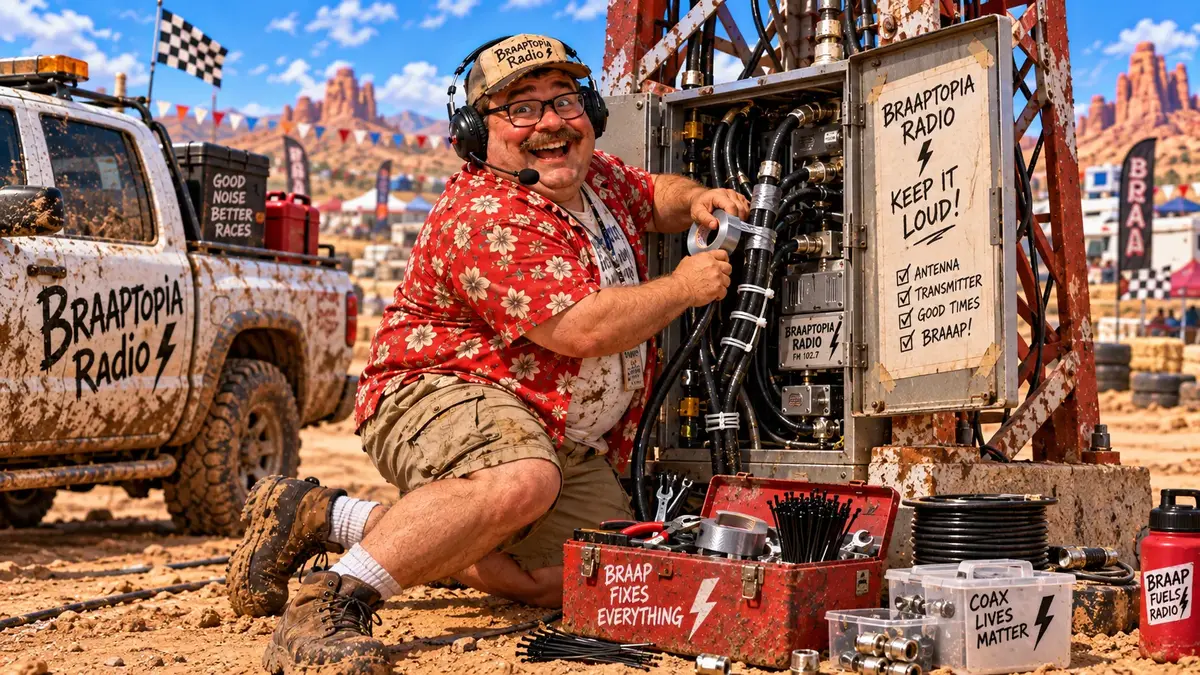
If you walk around behind the Garage, past the back wall where few guests bother to go, you will find something that stops you in your tracks.
It is an old pickup, rusty and battered, with BRAAPTOPIA RADIO on the doors. It has jet engines. Several. And, if the shape of the thing means anything at all, it flies.
Most visitors walk around it twice and then say the only reasonable thing, which is some version of what is that? Nobody will tell you, at first. The truck simply sits there being inexplicable until you work it out for yourself, and by then you will not be entirely sure you wanted to.
Journalistic Independence
Here is what is generally understood, once you have been on the island a while, and we want to be fair to it, because every step of it holds up.
Radio Guy covers the races. Since the bridges came down, the races are out on the islands, across open water, so a radio man with a folding table, a cooler, some extension cords and a prayer needs a way across the bay. The obvious answer is to ride with Hot Wings, like everybody else.
But the station reports on Hot Wings. It reads their disclaimers every hour. It covers the airspace, and the vertical separation, and the tracking that says probably. A news organization cannot depend for its transport on the air service it covers; that is the first thing anyone learns about journalism, or at least the first thing Radio Guy learned, from a book he found on the bus. So the station needed its own aircraft. The station also had no budget. The cheapest aircraft is one you already own. The station owned exactly one vehicle, which was the pickup, and the pickup was in every respect suitable except that it did not fly, which was a gap, and gaps on Braaptopia are closed with whatever is lying around the Shed. What was lying around the Shed was jet engines. Several were fitted, because a station that refuses to depend on any one air service can hardly depend on any one engine.
The result is that Braaptopia Radio is the most independent news organization on the bay. It answers to no airline, no sponsor, no budget and, once the engines are lit, nobody on the ground. That the bay already had boats and helicopters and seaplanes crossing it all day, any of which could have carried a folding table, is not considered relevant. Those were other people's vehicles. This one is the station's.
The Old Work Platform
Some of the older hands tell another story. They say that long before it was a remote broadcast vehicle, it was the tower work platform, the machine the crew used to hang things on the tower before the Skycrane. Ask how the great BRAAPTOPIA RADIO sign got up there near the top, and they will nod toward the truck and say: How do you think?
Nobody knows if this is true. If it is, it means the island's habit of servicing an eleven-hundred-foot tower by helicopter is not reckless at all, but a considerable improvement in safety, and the Skycrane, which visitors find alarming, is in fact the cautious option, chosen by people who had seen the alternative. Waylon, who flies the Skycrane, has said he is aware of this and finds it a comfort. Some say that, come the holidays, the old truck should go back up the tower to string Christmas lights. This has been discussed. It has not been ruled out. Waylon has asked to be told in advance.
The Fires
Braaptopia, it must be said, has a curious number of wildfires.
They break out on the outer islands, never on the resort itself, one island at a time: big, angry, smoky blazes, sometimes high on a ridge, sometimes deep in a gully. When one starts, the call comes in to the Flight Base, and it goes something like this:
The phone rings at Hot Wings. Waylon picks up.
"Hey, WTF… It's… Radio Guy."
"Another fire?"
"Another fire."
"We're on it."
And out from her berth comes the Braaptopia Fire Scooper.
The Biggest Water Scooper in the World
The Fire Scooper is a big seaplane that skims the surface of the bay, scooping up water as it goes, then flies to the fire and drops it. Ordinary fire scoopers have two engines.
The Braaptopia Fire Scooper has four. Jet engines. The reasoning was put to the island at the time and accepted without dissent. A fire scooper needs to carry as much water as possible. More water needs a bigger plane. A bigger plane needs more engines. More engines can carry more water. And since this sequence has no natural stopping point, somebody had to choose one, and the person who chose it said, simply, this one goes up to eleven, and that was that. It is, by Braaptopia's own unverified reckoning, the biggest water scooper in the world. It carries five thousand gallons, and when it drops, it lets go of all of it at once, in a long, broad, six-second curtain of water.
Fully loaded it is heavy and slow and determined, and you feel every gallon. You follow the smoke out, read the land, come in low over the ridges with your wingtips nearly brushing the hills, then go back to the bay, skim it, and do it again. After each drop Waylon reviews your work over the radio. When you do well, he says so as WTF, crisp and businesslike. When you miss, he coaches you quietly, as Waylon. It is the same man either way. He simply has two voices, the way a good teacher does, and you will learn which one you have earned. And when you have knocked the fire almost all the way out, he calls you home:
"That's enough from the air. Radio Guy can handle the remaining hotspots. Return to base."
First One There Again, Apparently
You may wonder why Radio Guy would be the one to handle the remaining hotspots.
It is because he is already there. He is always already there.
WILDFIRE · QUESTIONABLE IGNITION
Radio Guy is already on scene. His truck is on a hilltop. First one there again, apparently.
Smoke will get you to the island. Island peaks are typically around 130 feet above the bay. Stay above the terrain on approach, and judge your drop height above the fire. You have the aerial view: survey the terrain and choose your approach.
And sure enough, as you fly over the burning island, you will see it, parked on a hilltop, not necessarily near the fire, just there: the old truck with BRAAPTOPIA RADIO on its doors. It is a useful landmark, if you are trying to find your way around an island in the smoke, which is a phrase nobody on Braaptopia has ever said aloud.
He is, the island agrees, not unusually eager about fires. It is simply odd that he is always first on scene. And it is odd that he has a jet-powered flying truck. And it is odd that the briefing describes the cause of every fire as questionable ignition. The island has considered these facts with great care, separately, one at a time, and found each of them perfectly explicable on its own, and has made a point of never considering them together, on the sound principle that you should not combine things you do not fully understand, which is also why it has never put the van in the water.
And afterward, when the planes have gone home, Radio Guy is left on the hilltop with a fire extinguisher, dealing with the last few hotspots on foot. He is soaking wet, because the last drop came a little closer to his position than he would have liked. He is hoping, very much, that the truck will start.
It usually does. Eventually.
There are guests who say that from the top of one of the hotels you may see the truck leave: lift off from behind the Garage with a roar and a gout of flame and head out over the water. And there are guests who say that if you look carefully at the ground behind the Garage, you can see scorch marks where it lands. These stories cannot be confirmed. Nobody has denied them, either.
ON AIR · BRAAPTOPIA RADIO
Breaking news: we have a fire on SXS Island. I'm on scene. I'm, uh, I'm always on scene, it's a... it's a coincidence, folks. It's a professional instinct. Radio people go where the story is, and sometimes the story is... on fire.
Scooper's inbound. I can hear it. You can hear it from here, all four engines, sounds like the end of the world. That's beautiful. That's beautiful radio.
Okay, they're lining up for the drop. They're coming in low, they're coming in low over the ridge, they're... okay, they're coming in right over my
[sound of five thousand gallons of water]
...We're gonna go to music.
Chapter FourteenThe View from the Roof

Two great hotels stand on Braaptopia, Hotel West and Hotel East: enormous white towers, oversized on purpose, the tallest things on the island except the tower. They are flat on top.
Getting to the top is the question.
The World Without You
From the roof you can see the whole resort laid out below, the tower close enough beside you to make you step back from the edge, and the five outer islands low and blue-green far out in the bay.
And if you stand there long enough, you will see the island going about its business without you. The Express tears across the bay in a plume of flame and spray, or the Island Hopper crosses, banking hard. Or the Skycrane lumbers in from the mainland with an antenna hanging from its cable, hovers over the tower for a few seconds, and lumbers off again without it. Or it arrives with nothing, hovers, and leaves with an antenna. Nobody asked why. Apparently they needed one.
It is a peculiar feeling, watching a place carry on without you. Most places make you feel it as a kind of loneliness. Braaptopia makes you feel it as an invitation. Everything down there is going on whether you join in or not, and that, somehow, is exactly what makes you want to.
And then the banner plane.
Chapter FifteenThe Long Evening
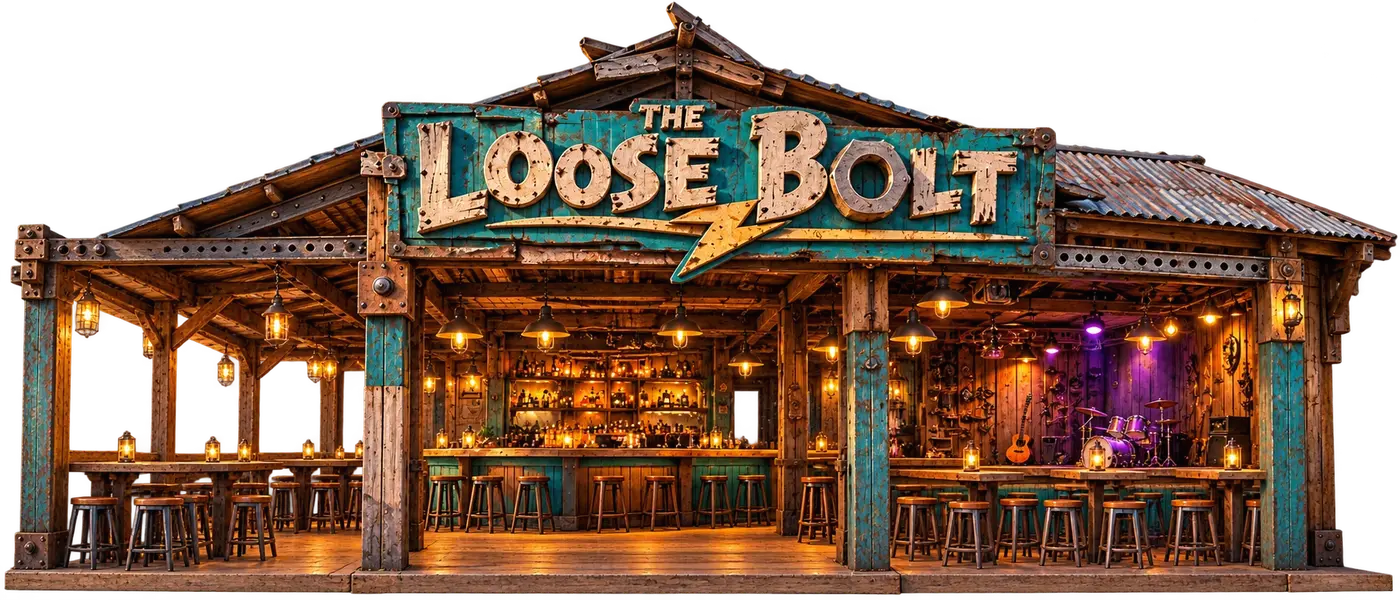
Night comes to Braaptopia slowly, the way an old dog lies down. The sun goes down over the bay in streaks of orange and purple. The Purple Lodge lights up from within. The tower's beacon blinks red. And the string lights come on at the Loose Bolt.
The Loose Bolt
The Loose Bolt is a timber-and-teal bar with a lightning-bolt sign, a patio under the string lights, and a stage out back. Its sign reads FOOD · MUSIC · QUESTIONABLE COMPANY, and it lives up to all three, sometimes simultaneously.
The kitchen is open until somebody finds the keys. This is not a figure of speech. The keys are always somewhere. When somebody finds them, the kitchen closes. Over the years this has produced a peculiar economy of not-looking, in which everyone in the building has a strong interest in the keys staying lost, and the keys, as a result, are the best-hidden object on the island, better hidden than the ten-millimeter socket, which at least turns up now and then. Leon, who is closing, is out on the patio with his horn. The bar is, by his figures, very nearly closed.
The Evening Goes On
This is the hour when Braaptopia is at its best.
The band plays on the stage behind the Loose Bolt, and the crowd sings along to the chorus they all know:
NO PLAN.
FULL SEND.
NO PROBLEMS.
There is a chant that goes with it, the island's own anthem: Welcome to Braaptopia. And the frontman takes the word braap and stretches it out across the whole bay, and the gulls leave, on cue, as they always do.
Then the set ends, and nobody leaves. They drift over to the pool, which is officially closed. Calvin takes his loungers. Willie's boots end up in the water. Somebody brings a cooler. The radio is on, low, from a speaker in a palm tree, and Radio Guy is still on the air in the late-night voice, taking requests from Marlene at the lakeside dock and Skeeter in the shop-fan aisle and Wanda on the back porch. He plays something slow. Then something not slow at all.
Songs of the Island
Braaptopia Radio has hundreds of songs in its library, and every one has a little story attached, written up by whoever was on duty when it came in. The stories are not really about the songs. They are about the island. Read enough of them and you start to feel you know the place (its picnic tables and golf carts and parts counters and lost-and-found bins) better than your own street.
Guardrail FM · Was last heard coming from a cooler that absolutely does not have speakers.
Open Headers · Made the picnic pavilion lights flicker in a way guests called "production value."
Flute Loot · Was caught cutting through the employee lot to avoid the speed bump.
Pipe Dream · Keeps showing up on the weather radar as a small but enthusiastic front.
Pan Flute Panic · Has been entered in the maintenance system with priority "eventually."
Minstrel Crisis · Has been issued a reflective vest and is taking the responsibility too seriously.
Denim Voltage · Won Employee of the Month despite not being an employee or technically alive.
Curb Service · Has been declared tax-exempt by a man who does not work in Accounting.
Scratch Bog · Received a noise complaint from a generator, which feels hypocritical.
Moonshine Exit · Was playing when the maintenance cart won a race nobody admitted was happening.
Exit Velocity · Was playing when the resort dog stole a radio and improved programming.
Lane Change · Was playing when the resort cat ignored everyone with unusual rhythm.
Hot Merge · Has been listed on a work order as both the problem and the solution.
Forklift Disco · Was playing when the campground host found the missing golf cart behind his own golf cart.
Rotor Dust · Has been asked to supervise the bounce house, which seems irresponsible.
Ditch Voltage · Keeps getting credited to "Various Artists" because Various refuses to take responsibility.
Organ Donor · Was discovered behind the stage with a lanyard and complete confidence.
Actuator Three · Was entered into the resort raffle and won a resort raffle.
Laser Washer · Was accidentally entered in the chili cook-off and still finished third.
Plastic Spark · Has been given a shelf in the pro shop even though there is no pro shop.
Parking Lot DJ · Has been assigned to Cabin 12 even though Braaptopia does not have cabins.
Torque Picnic · Was playing when the campground map gained a hand-drawn shortcut labeled TRUST ME.
Loose Lug · Was found on a USB stick labeled TAXES, which explains nothing.
Floor Jack · Garage-floor machine boogie. Radio Guy says the truck was like that when he found it.
Cinderblock · Blunt-force Texas stomp engineered from four chords and leftover tower ballast.
Gravel Teeth · Low-slung boogie with enough bite to remove paint from a guardrail.
Pressure Plate · Texas machine chug triggered by something Maintenance said not to stand on.
Scrap Royalty · Was playing when someone tried to return mud to Lost & Found.
College Radio · Keeps getting blamed for the mysterious disappearance of ten-millimeter sockets.
Library Fine · Has a tiny fan club near the dumpster and all four members are raccoons.
Neon Forecast · Has been adopted by the night janitor as a motivational seminar.
There are raccoons, then. Four of them, at least, near the dumpster, with a fan club. And this explains the goat.
There is a goat on Braaptopia that calls in on the maintenance channel, now and then, to insist that it is absolutely not a raccoon, and its position is more reasonable than it sounds. On an island where raccoons have a fan club, they also have a reputation, and anything moving near the dumpster after dark is presumed to be one. A goat near the dumpster after dark (its reasons for being there are its own) therefore faces a presumption, and the only way to rebut a presumption is to state the contrary early and often. Unfortunately, everybody also knows that nobody insists they are not a raccoon unless the question has come up. So every call raises a little more suspicion, which requires another call, which raises a little more. It is the same mechanism that sells Hot Wings, and the goat, like Waylon, understands it perfectly, and has decided that it cannot in good conscience stop correcting the record.
The Station Signs Off (But Never Really)
Late, very late, after the band has gone quiet and the pool has emptied down to Calvin, who is asleep, and Leon, who is about to leave, the radio is still playing. From its rack somewhere in the dark the station reports that the magic smoke is still inside, and the crawl, scrolling across a screen nobody is watching, announces that this hour has been brought to you by nobody. Somewhere out on the bay, the Express's wake is still settling. Somewhere behind the Garage, a truck that should not fly is sitting quietly in the dark, perhaps a little warm.
And Radio Guy says goodnight, the way radio people do, which is to say, not really.
ON AIR · BRAAPTOPIA RADIO
It's late, folks. It's late and we're still here. That's how you know it's a good night.
To everybody out there, at the dock in Michigan and the shed behind the shed in Alabama and the camper with one good speaker in Oklahoma: thanks for hanging out. To everybody still at the pool: the pool is closed. I know you know. I know you don't care. Calvin, I can see you from here.
Leon says he's going to play one more. He said that four songs ago.
This is Braaptopia Radio. More hits than the guardrail. We're not going anywhere. Nobody ever does.
EpilogueAssistant Director of Questionable Decisions

You came for the weekend.
You came to drive a rally car around in the mud and maybe hear a few songs. You did not intend to stay. Nobody ever does.
But somewhere along the way you found the ten-millimeter socket on the workbench, and you met the guitarist's eye and saw that he knew, and you watched the bassist claim a table, two loungers and the entire lower end of the frequency spectrum. You inspected Radio Guy's credentials and learned that nobody else showed up. You found the festive dashboard, and the keyboardist's one-finger fix, and the sax player's one more song, and the safety director's signature, which was a tire mark.
And then, one afternoon, the island let you know, quietly, that something had changed:
ALL EIGHT DISCOVERIES FOUND.
You are now Assistant Director of Questionable Decisions.
All inspections complete. No problems found.
It is worth taking a moment to understand the position, because it is the most secure job on the island, and the reasons are entirely sound.
An Assistant Director reports to a Director. The only Director on Braaptopia is the Acting Director, and his whole claim to the office, written on his own badge, is that nobody else showed up. You, however, showed up. Strictly speaking, then, your arrival has put his appointment in question. But the only person with the authority to question it is the Director, who is him, and he has no intention of doing so. So you report to a man whose position depends on your not existing, and he reports to nobody, and neither of you can be removed, because removal requires a superior, and there isn't one. Nobody can promote you, demote you, or let you go. You are, in the most precise sense available, permanent.
There is no badge for this. You will have to make your own. Find a scrap of cardboard. Find a marker. Write it on there, in your best handwriting, and hang it on a lanyard around your neck. It will be every bit as official as everyone else's, which is to say completely, because on Braaptopia that is how official works.
And now you have a job. Nobody hired you. Nobody officially employs you. But you have a job, and a room, and a buggy with the keys in it, and a radio that never stops playing. Somebody needs a hand down at the Shed. The tower wants another antenna. There is a fire on Dirt Island, and Radio Guy is on scene. Again.
You could leave, of course. The gate is right there. The boats run. The planes fly.
But the band is about to start. And Leon says it's just one more song.
WELCOME TO BRAAPTOPIA
NO PLAN · FULL SEND · NO PROBLEMS
AppendixThe Braaptopia Radio Operations Manual
BRAAPTOPIA RADIO
OPERATIONS MANUAL
(UNOFFICIAL)
REVISION: WHICHEVER ONE THIS IS
LAST UPDATED: BEFORE STEVE LEFT
COMPILED BY: NOBODY, TECHNICALLY
APPROVED BY: MANAGEMENT (PENDING RETURN FROM LAKE)
DO NOT REMOVE FROM STUDIO
There is no manual for Braaptopia Radio. There never has been. Every station in the world has a binder somewhere, full of procedures and diagrams and phone numbers, and every engineer who has ever worked at one knows that the binder is out of date. Braaptopia Radio skipped the binder and went straight to being out of date.
What follows is the closest thing it has. It was found on the shelf by the patch bay, between a box of fuses in the wrong size and a coffee can full of zip ties. It covers the station, the tower, Engineering, and the ghosts. It is not complete. Nothing here is. But if you have been handed a radio, or a set of padlock keys, or a page that says NOPE. STILL YOU., this is where you start.
CONTENTS
§1 · The Station: no sponsors, the crawl, the request line, the cameras, the break room, the crew, and how to take over the board
§2 · The Tower: readbacks, the bulb, and the sign
§3 · Engineering: the eight specialties, the rules, the Emergency Action Panel, Don't Touch This, the Loud Thing, and Brain Melt
§4 · The Ghosts in the Rack: S.P.E.C.T.R.E., the recognition guide, the rooms, and the closeout
§1 · The Station
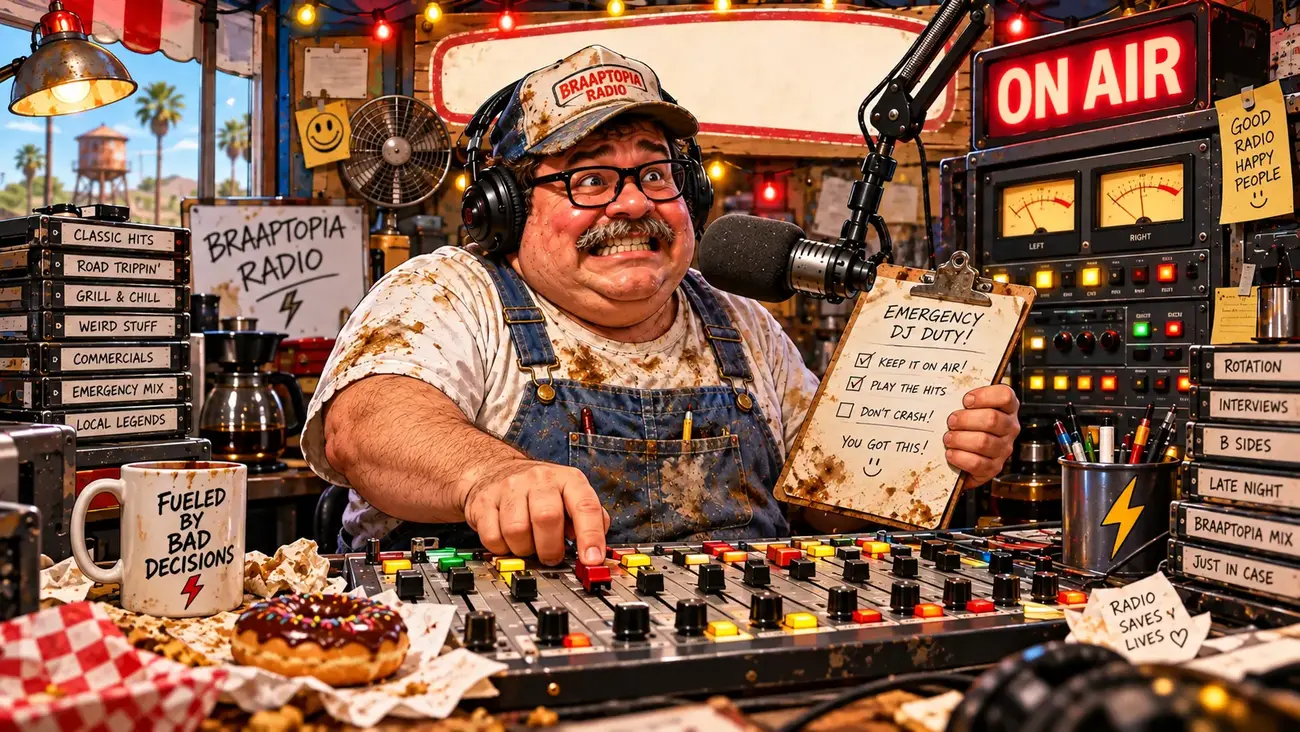
Braaptopia Radio was the first thing on the island to be ready, and it has never been entirely ready since.
The studio stands on the resort grounds with a porch out front, a hand-carved wooden sign over the door, and an ON AIR light that has never, in living memory, been switched off. Step inside, and you will find yourself in what can only be described as a broadcast shrine built entirely from salvage and enthusiasm. There are old cart machines, the kind that radio stations used decades ago to play jingles and commercials from little plastic cartridges, stacked three high. There are racks of battered equipment, their front panels a patchwork of mismatched knobs and switches. There are analog meters with needles that twitch in time with the music, blinking lights in every color, cassette decks, a mixing board with half its faders labeled in marker, duct tape on everything, and cables running in every direction like the roots of a very confused tree.
On the wall hang the signs that tell you everything you need to know about the station's philosophy:
NO BUDGET.
SURPRISINGLY FUNCTIONAL. ENGINEERING POWERED
BY DUCT TAPE. IF YOU HAVE ZIP TIES,
WE'RE HIRING. SAME ANTENNA.
DIFFERENT ATTITUDE. GOOD MUSIC · CHEAP BUDGETS
BIGGER VIBES FUELED BY BRAAP
And over the door, carved in the wood, the station's founding statement of fact:
The tower is up. The transmission line is completed. Still no budget, and lots of duct tape was used. Have any zip ties we could borrow?
The Station Nobody Would Sponsor
Braaptopia Radio has no commercials. Visitors from the outside world sometimes find this charming and assume it is a matter of principle, that the station has nobly refused to sell out. This is not the case. The station has no commercials because, in the plain words of the people who run it, nobody would sponsor this.
Nobody. Not one advertiser. Not one brand. The station's sales department, which exists in the sense that it has a desk, has been asked to stop. Its quarterly pipeline consists of one guy who said maybe. Its most recent trade agreement was for two hot dogs and a patch cable. Its rate card is handwritten and subject to weather. Its sales forecast is partly cloudy with a 0% chance of commission.
And so, in the gaps where commercials would go, the station tells you who paid for the next few songs. The answer is always nobody. A crawl runs along the bottom of every screen at the station, and it is mostly devoted to this subject:
THIS HOUR BROUGHT TO YOU BY NOBODY. ✦ COMMERCIAL FREE BY LACK OF INTEREST. ✦ UNDERWRITTEN BY POOR DECISIONS. ✦ NO BRAND WANTED THEIR NAME NEAR THIS. ✦ PROMOTIONAL CONSIDERATION PROVIDED BY EXTENSION CORD. ✦ OFFICIAL PARTNER OF ABSOLUTELY NO ONE. ✦ IF YOU REPRESENT A MAJOR BRAND, PLEASE PRETEND YOU NEVER SAW THIS. ✦ TODAY'S PROGRAMMING FUNDED BY WHATEVER WAS LEFT AFTER BUYING ZIP TIES. ✦ BROUGHT TO YOU BY A RECEIPT WE CANNOT FIND. ✦ THE NEXT TWO CUTS ARE PRESENTED BY A COOLER WITH ONE GOOD HINGE. ✦ THIS HOUR IS POWERED BY A GENERATOR THAT HAS ASKED NOT TO BE NAMED. ✦ THIS SONG SET IS BROUGHT TO YOU BY THE GUY WHO SAID "THAT SHOULD HOLD." ✦ THIS HOUR BROUGHT TO YOU BY KIELBASA. KIELBASA HAS NOT BEEN CONSULTED. ✦ THIS HOUR BROUGHT TO YOU BY OUR STRONGEST DEMOGRAPHIC: PEOPLE ALREADY HERE. ✦ NO SPONSORS. NO MAKEGOODS. NO PROBLEM.
The Paradox of the Toys
And yet.
And yet, for a station with no budget, no sponsors, and a sales department that has nothing to sell, Braaptopia Radio has a great deal of equipment. Ridiculous equipment. Equipment that does not seem possible.
It has a live, working audio processor that any visitor may adjust, labeled DON'T TOUCH THIS. It has a battered industrial sampler called Test the Loud Thing. It has a listener-tracking display that looks like a military radar console. It has a bank of security cameras, a psychedelic visualizer that can be entered only after signing a warning, a training simulator with a government-sounding acronym for finding ghosts in its own equipment racks, and an emergency action panel full of very large buttons.
How did a station that is, in its own words, basically a guy at a card table behind a pickup truck at Turn 2, come to own all of this?
Nobody knows. That is the official answer and the only answer. Nobody knows how it was paid for, who ordered it, or how it got here. Engineering does not know how half of it works. The question is regarded, on the island, as slightly impolite. You do not ask how Braaptopia Radio afforded its toys, any more than you ask how the tower stays up. You simply accept that they exist, enjoy them, and try not to touch anything labeled TEMPORARY.
The Station Is Always Running
Braaptopia Radio does not stop. It does not start, either, in any meaningful sense. It was already going when you arrived, and it will still be going when you leave, and it follows you everywhere in between.
Walk from the resort into the studio, and the song does not restart. Leave the studio for the garage, and the same song carries on through the buggy's dashboard. Climb into a rally car on Rally Island, or a helicopter on the Flight Base pad, or the cockpit of a jet boat on the north shore, and the radio is there, playing, the same station, the same voice, picking up where it left off. It is the island's bloodstream. Radio Guy is the connective tissue; the station is the blood. One long-time guest described the music as something that overrides everywhere you go, and added, with feeling, that it freakin' jams.
The station plays in a rhythm. Music, then a liner (a short sung or spoken station identification, usually involving the word Braaptopia sung at a volume that makes the windows hum), then more music, then a break where Radio Guy or one of his colleagues tells you something you did not need to know, then music, then the weather, then music, then the news. It is a personality-heavy format, much heavier than any commercial station in the outside world would dare. This is on purpose. As the station's programmers have noted, a real radio station might play the personality pieces less often, but in Braaptopia, it is the personality, so it runs often.
The Weather Is Mostly Dirt
Braaptopia Radio's weather forecasts do not concern themselves with clouds or barometric pressure. The weather, at Braaptopia, is the condition of the dirt.
BRAAPTOPIA TRACK WEATHER: DIRT CURRENTLY TACKY WITH PATCHES OF HERO DIRT. ✦ TRACK CONDITIONS: MUD IN SHADED AREAS, REGRET IN SUNLIT AREAS. ✦ FORECAST: 100% CHANCE OF SOMEBODY ASKING IF THE TRACK WILL DRY OUT. ✦ CONDITIONS: TACKY IN THE TREES, POWDERED DONUT IN THE OPEN. ✦ TRACK REPORT: INSIDE LINE WET, OUTSIDE LINE BRAVE. ✦ SURFACE REPORT: BRAKING BUMPS DEVELOPING A ZIP CODE. ✦ FORECAST: CLEAR SKIES, LIMITED VISIBILITY DIRECTLY BEHIND ANYONE FAST. ✦ TRACK CONDITIONS: FIRST LAP SLICK, SECOND LAP INTERESTING, THIRD LAP SOMEONE'S PROBLEM. ✦ WEATHER: NO RAIN. PUDDLES REMAIN FROM HISTORICAL EVENTS. ✦ SURFACE REPORT: LOOSE OVER HARD, WHICH IS BOTH A CONDITION AND A THREAT. ✦ TRACK CONDITIONS: RUTS HOLDING WATER AND GRUDGES.
The News Is Mostly Racing
And the news, naturally, is about whoever just did something spectacular, or spectacularly ill-advised, on one of the tracks.
BRAAPTOPIA RACING NEWS: LEADER STILL LEADING, SOURCES CONFIRM. ✦ TRACKSIDE UPDATE: SOMEBODY SENT IT TOO DEEP AND HAS ENTERED THE SHRUBBERY. ✦ BREAKING: HOLESHOT DECLARED EXTREMELY HOLESHOTTY. ✦ BREAKING: RIDER REPORTS THE DIRT WAS, IN FACT, DIRT. ✦ RALLY UPDATE: CO-DRIVER REPORTS "LEFT" WAS TECHNICALLY CORRECT. ✦ ATV UPDATE: ONE FENDER NOW HAS INDEPENDENT CAREER PLANS. ✦ MX UPDATE: LANDING DESCRIBED AS "MOSTLY ON THE BIKE." ✦ RESULTS DESK: THIRD PLACE VERY PLEASED WITH THIRD PLACE AFTER SEEING SECOND PLACE. ✦ RACE UPDATE: LEAD CHANGE OCCURRED WHILE EVERYBODY WAS LOOKING AT THE SAUSAGE CART. ✦ PIT DESK: CREW CHIEF HAS SAID "SEND IT" AND WALKED AWAY. ✦ RACE CONTROL: DUST CLOUD HAS BEEN ASSIGNED A NUMBER. ✦ TRACKSIDE NEWS: SAUSAGE CART OUTSELLING MERCH BY A CONCERNING MARGIN.
The Sausage Cart
You may have noticed, by now, a recurring mention of a sausage cart.
It is real. Nobody can tell you who runs it. It appears at trackside remotes, at the edge of the paddock, near the pit entrance, wherever a crowd is gathering or might be persuaded to gather. It sells kielbasa, Italian sausage, sauerkraut, mustard, and hot dogs, and it is, by every available measure, the most successful commercial enterprise on the island. It has its own traffic queue. It has, on at least one occasion, outsold the official merchandise. There is a security camera dedicated to it, labeled SAUSAGE CAM, whose description reads, in full: Kielbasa, Italian sausage, sauerkraut, and absolutely no engineering discipline.
When Radio Guy's backup DJ was once deployed in an emergency, the backup DJ found the hot dog cart, set up the broadcast beside it, and somehow improved the show. This has been noted in the records.
The station's sponsorship crawl has more than once thanked the sausage cart for underwriting a block of music. The sausage cart has never agreed to this.
The Request Line
The phones at Braaptopia Radio ring constantly. People call in from everywhere: from a tractor shed in Nebraska, an airboat ramp in Florida, a mud-hole lookout in Louisiana, a toolbox fort in Texas, a snowblower bunker in Minnesota, the shed behind the shed in Alabama, a camper with one good speaker in Oklahoma, and a workbench by the freezer in Illinois. Their names are Bubba and Tammy and Skeeter and Darla, Big Mike and Tiny Mike, Loretta and Earl and Cletus and Wanda. And each one of them has a reason.
REQUEST LINE · NOW ON THE BOARD
Caller Marlene, lakeside dock, Michigan: says this one absolutely rips.
Caller Big Mike, generator room, Arkansas: needs something loud enough to find a 10 mm socket.
Caller Loretta, gravel driveway, Tennessee: claims the neighbor texted "turn it down," which counts as a request.
Caller Skeeter, shop fan aisle, Ohio: says the subwoofer has been underemployed.
Caller Wanda, back porch, Georgia: wants to hear what poor financial decisions sound like.
Caller Cletus, camper with one good speaker, Oklahoma: says management has been too responsible lately.
Caller Tiny Mike, parts counter, Missouri: requests a tune for staring at an engine bay knowingly.
The calls come in faster than anyone can play them. This is, in the station's view, exactly right. Each request is kept on a little paper ticket, so the jokes don't vanish when the next call comes in, because, as somebody at the station once put it, those jokes are good, but they disappear as soon as the next request comes in. So the tickets pile up, and you can work through them in any order you like, adding them to the playlist one at a time. The station will always slip a liner in before a requested song, to keep the music from bumping into itself. The programmers call this practice Funky Organized Chaos.
The Listener Map
To keep track of all these callers, the station has a Listener Map.
It is not really a map. Nobody pretends otherwise. It is an elaborate, glowing, over-engineered screen of radar sweeps, locator rings, telemetry readouts, and little blinking dots, labeled with phrases like RF LOCATOR MATRIX, SCAN DEPTH NOMINAL, and AUDIENCE TRIANGULATION. It looks as though it was designed to track submarines. What it actually tracks is Marlene at the lakeside dock and Bubba at the airboat ramp, and occasionally somebody in a shed complex in Ireland. There is a button labeled ROLL CALL that refreshes the whole display. Nobody knows what it is measuring. It looks incredible.
The Cameras
The station has security cameras. Seventeen of them, more or less, though the count depends on who you ask and which ones were plugged in that day. The station's own description of its camera system is that it is completely fake, and somehow more believable for it.
The camera feed cycles on its own through the station's archive of footage. Each camera has a label, and the labels are, according to the system's own status readout, currently more confident than accurate. The camera router is unsupervised. The archive is organized by vibe. Its source, on a good day, is probably our camera.
CAM 01 · MAIN STUDIO
Operator pretending this is under control. CAM 02 · DJ BOOTH
Actual queue management is underway. Hide the paperwork. CAM 04 · EMPTY CHAIR
Nobody is visibly at the controls, which is somehow normal here. CAM 05 · UNDER RACK
Somebody is under the desk doing engineering by touch and prayer. CAM 07 · HOUSE BAND
The junkyard house band has materialized and refuses to calm down. CAM 09 · HOUSE BAND
The junkyard house band has escalated to full idiot rock opera. CAM 10 · PARTY MODE
Visibility is optional. Vibes are mandatory. CAM 11 · TROUBLE
Please stand by while unlicensed genius occurs off-screen. CAM 12 · TRACKSIDE REMOTE
Major-market polish, folding-table infrastructure, and one extension cord with a prayer. CAM 13 · SPECIAL GUEST
Exclusive interview with someone who would rather be driving. CAM 15 · INTERN
Checklist in hand, confidence not included. CAM 17 · HOT DOG DESK
The backup DJ found a hot dog cart and somehow improved the show.
The footage is, in the station's own phrase, so detailed it's hilarious. You can browse the whole archive if you like, with buttons marked PREVIOUS EVIDENCE and NEXT EVIDENCE. You will see Radio Guy on the air in a sausage-stained apron. You will see him under the desk with a fistful of cables. You will see the empty chair, a half-eaten donut, a coffee mug that says FUELED BY BAD DECISIONS. You will see the house band in the studio, the house band at the finish line, the house band at brunch, the house band asleep in the booth. You will see the trackside remote: a canopy, a folding table, a cooler, a pickup truck plastered in station decals, a power strip doing more than any power strip should, and Radio Guy, grinning, interviewing a mud-caked race winner whose sign reads STILL FULL OF DIRT.
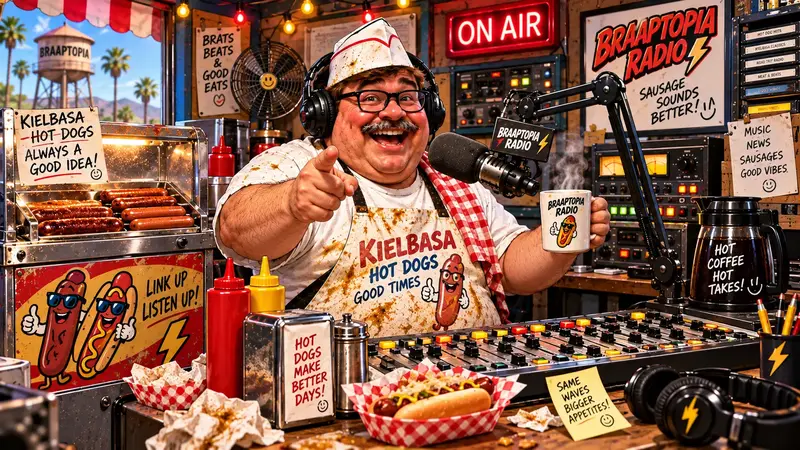

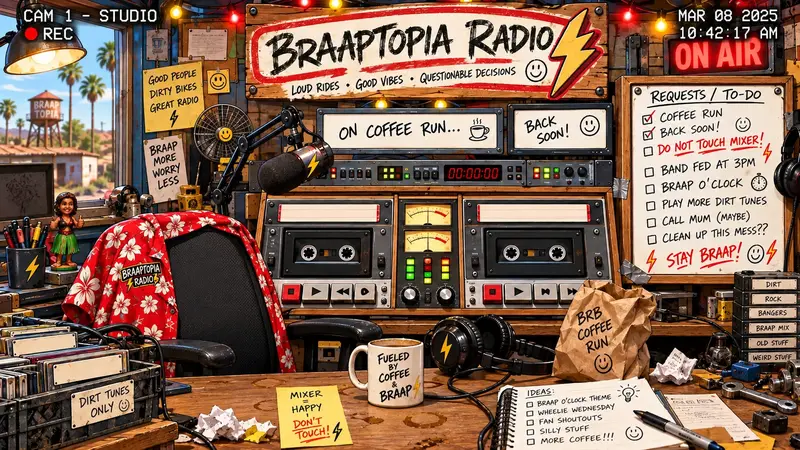
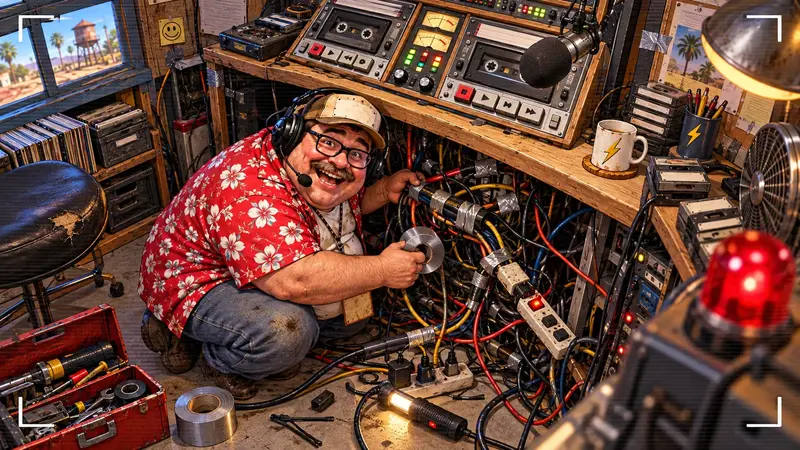
The Break Room, and Other Infrastructure
No account of Braaptopia Radio would be complete without the break room, because the break room is where most of the station's crises actually occur.
The station maintains a situation board (a live ticketing system for problems) and a surprising number of its open tickets concern food. Each one moves through the station's official stages of resolution, which are, in order: OPEN, WAITING, ASSIGNED, MONITORING, FIXED-ISH, and YOUR PROBLEM.
BREAK ROOM — MICROWAVE ARCING Burrito rotated 90°. Incident downgraded to lunch.
BREAK ROOM — KIELBASA DEPLETION Inventory says zero. Refrigerator says check behind the pudding cups.
VENDING — CHIPS CRITICAL Only barbecue remains. Morale implications under review.
POP-TART RESERVE — LOW Brown sugar cinnamon declared essential infrastructure.
BURRITO DRAWER — EMPTY Nobody admits there is a burrito drawer. Ticket remains open.
BREAK ROOM FORK SUPPLY 47 spoons. One fork. Fork currently signed out to engineering.
COFFEE MAKER — SURFACE FILM Film now thick enough to have weather. Cleaning deferred pending archaeology permit.
KIELBASA — MICROWAVE EVENT Odor reached transmitter room before the page did.
TOASTER — SET TO 6 Nobody knows who needs toast this brave. Setting preserved for evidence.
The coffee machine was once scheduled for descaling. The descaling was delayed after the machine was promoted to senior staff. A coffee committee was formed to address coffee quality. The coffee worsened during the committee's first meeting.
Who Else Works Here
It is difficult to say exactly who staffs the station, because people at Braaptopia tend to be known by what they are doing rather than who they are. The voices that come in over the maintenance talkback channel identify themselves by job, not by name:
WELDER: needs more top.
PARTS: play the fast one.
TRACK CREW: who moved my cone.
UNKNOWN: generator sounds expensive.
GOAT: absolutely not a raccoon.
RADIATOR HOSE: stop leaning on the compressor.
FENCE GUY: the loud thing is louder.
CHEW CHIEF: the sausage cart is drawing a crowd.
TOWER GUY: the zip ties are structural now.
GENERATOR: not a person, still requesting a break.
TRACK CREW: radio sounds good from the porta-john.
WELDER: found the hum. It was me.
ENGINEER: do not unplug the orange cord. Seriously.
UNKNOWN: something in rack three just sighed.
PARTS: we have the adapter. We do not have the adapter for the adapter.
ENGINEER: found the missing vice grips. They are holding the refrigerator handle on.
You will notice that some of these voices do not belong to people. The Generator has asked for a break. A Radiator Hose has opinions. And there is the matter of the Goat. A goat calls in on the maintenance channel. The goat insists, every single time, that it is absolutely not a raccoon. Nobody has accused it of being a raccoon. Nobody knows why it feels the need to clarify. It is best not to ask.
There is an Intern, who may be deployed by pressing a large button marked SEND INTERN on the station's emergency panel. The Intern goes somewhere. The destination is generally unconfirmed. There is an Emergency Backup DJ, deployed by a button marked DEPLOY BACKUP DJ, who has been located on at least one occasion and immediately put on the microphone. There is someone named Earl, whose only recorded contribution to station operations is that, during one particularly chaotic hour, the scheduled news was replaced by whatever Earl heard. Nobody knows who Earl is. His information was apparently good enough.
Be the DJ
You do not have to merely listen to Braaptopia Radio. You may take it over.
There is a button in the studio labeled BE THE DJ. Press it, and the cart decks slide out across the workbench, and the whole station is yours: every song, every liner, every news break and weather report and goofy station sweeper, laid out in a library of little cartridges. You may stack them in any order you like. The live station keeps playing while you build your set. Nothing goes on the air until you say so. And then it does, and you are on the air on Braaptopia Radio, and the island is listening to you.
Programming a radio station is harder than it looks. Music, the station will tell you, is the foundation. Liners are the station's identity. Breaks are its personality. Weather and news are what make it feel live. Put two songs back to back and the station will helpfully slip a liner between them, unless you tell it not to, because you are the DJ and the station respects that.
When your set runs out, a notice will appear:
YOUR DJ STACK IS EMPTY.
MANAGEMENT HAS RETAKEN THE BOARD.
Nobody knows which management. Possibly the lake.
Before you leave, you can sign the Guest DJ Book, which lies open on a stand like an old hotel register. You spun the tunes, it says. Now leave your mark. Write your name, the date, a few words, and give the place a star rating. Your entry will be reviewed by the staff and, if approved, added to the book's pages, where future guests can turn through them. The book's motto is printed at the top of every spread:
Good tunes. Questionable DJs. Great company.
The house crew left the first few entries, back when the book was new. The zip ties are structural. Please stop asking, wrote one. Found the missing 10 mm socket. It belongs to someone else, wrote another. Everything worked until somebody said everything was working. Sound check complete. Good judgment still pending. And one, in a hand that might have been Radio Guy's: Still engineering something new. Send zip ties.
§2 · The Tower

You saw it from the road. Everyone sees it from the road. You saw it from the boat, if you came by boat, and from the air, if you came by air, and you will see it from every corner of the island no matter which way you face, because it is very, very tall, and there is nothing else on Braaptopia nearly so tall, and it has been placed, with great care, exactly where it will be most in the way.
The Braaptopia Radio tower rises roughly eleven hundred feet above the island: a red-and-white lattice of steel climbing into the sky, festooned with hardware. It is festooned in the sense that a Christmas tree is festooned, if the Christmas tree belonged to someone who could not say no to ornaments. Antenna arrays sprout from every level. Dishes cling to its sides. There are service ladders, crown hardware, beacon mounts, cable runs, mysterious boxes, and at least one twisted horn antenna, the purpose of which is classified by virtue of nobody knowing it. Near the top hangs the great BRAAPTOPIA RADIO sign, which on special occasions erupts in flame.
Visitors who know something about broadcasting often stop and stare at it for a long time. They ask the obvious question: why does a small local radio station that cannot find a single sponsor need a tower like that?
Nobody has an answer. The tower is overloaded. This is not an error. It is the tower's personality. It has more antennas than any tower should, and it keeps getting more, and every one of them seems to require maintenance, which is why there is almost always a helicopter hovering near the top of it with something dangling from a cable.
The Readbacks
The tower reports its status to the studio constantly, and the readbacks are among the most beloved pieces of station literature:
TOWER STATUS: UNNECESSARILY READY — COURTESY WHOOMPH AVAILABLE ON REQUEST ✦ TOWER STATUS: FLAME PATH VERIFIED — CARTOON FLAME TRAJECTORY WITHIN TOLERANCE ✦ TOWER STATUS: PILOT LIGHT STANDBY — SMALL FLAME. BIG ATTITUDE. ✦ TOWER STATUS: SIGN STANDING BY — CALL LETTERS CURRENTLY SPELLED CORRECTLY ✦ TOWER STATUS: CEREMONIALLY ARMED — PAPERWORK FEELS UNEASY ✦ TOWER STATUS: VERTICALLY CONFIDENT — GUY WIRES REMAIN MOSTLY DIPLOMATIC ✦ TOWER STATUS: RF LEAVING PROPERTY — NEIGHBORS RECEIVING FREE PHYSICS ✦ TOWER STATUS: ANTENNA BAY COUNT UNCHANGED — THIS IS CONSIDERED A WIN ✦ TOWER STATUS: LIGHTS BLINKING — AVIATION REMAINS REASSURED ✦ TOWER STATUS: STRUCTURALLY OPTIMISTIC — ZIP TIES ARE NOT PART OF THIS READING ✦ TOWER STATUS: CLIMB DEFERRED — ENGINEER FOUND BINOCULARS ✦ TOWER STATUS: BIRDS UNIMPRESSED — FIELD STRENGTH REMAINS DISRESPECTFUL ✦ TOWER STATUS: SITE LOCKED — KEY IS DEFINITELY WITH SOMEONE
The Bulb
At the very top of the tower is a beacon: a red aircraft warning light that blinks, day and night, to keep the island's considerable air traffic from flying into it. The beacon has a bulb. The bulb occasionally burns out. When it does, somebody has to climb eleven hundred feet of steel and replace it.
You may have guessed where this is going.
BROADCAST TOWER — MAINTENANCE REQUEST The broadcast tower has a maintenance request. Somebody needs to get up there and replace the beacon bulb. Engineering has thoughtfully volunteered you.
The ladder passed every inspection we did not schedule.
But you will not be making the climb alone, in a sense, because it is Radio Guy who goes up. Of course it is. Of course he would be climbing the tower too. He trades the Hawaiian shirt for a flannel work shirt, puts on jeans, boots and a hard hat, and straps into a reflective climbing harness, with an X across the back, leg straps, a waist belt, and a tie-in rope. The reflective tape on the harness catches the sun and twinkles as he moves, so that from the ground he looks like a very determined, very large Christmas ornament working its way up the tower.
He does not climb so much as launch. Hold to hold, he slings himself upward on his tether, swinging and catching, swinging and catching, past the arrays and the dishes and the twisted horn, while the wind tugs at him and the island shrinks beneath his boots. Sometimes he misses. When he misses, he falls. Then the rope catches him, he swings out over nothing in a long, slow, horrible pendulum, the whole world goes quiet, and then he grabs hold again, laughs, and keeps climbing.
And when he finally reaches the crown and replaces the bulb, he stops and looks around. That is the moment. The camera pulls back. Late-afternoon light pours across the bay. The whole island turns slowly beneath him: the lodge, the pool, the five arches and the five islands beyond, the boats and the water and the far mainland and Far Harbor. And it hits you, the way it hits everyone who makes the climb: we are very, very high in the air.
How Did the Sign Get Up There?
It is a fair question, and people on the island like to ask it of newcomers: How do you think that sign got up there, anyway?
The answers vary. Some say a helicopter. Braaptopia does have a heavy-lift Skycrane, and these days it does most of the antenna work: it arrives with an antenna dangling below it, hovers over the top of the tower for a few nervous seconds, and flies away without it. Or it arrives empty and flies away with one. Nobody asked why. Apparently we needed one.
But there is an older story. There are people who will tell you that, before the Skycrane, the tower crew used a different piece of equipment entirely, a work platform, and that this platform was not, strictly speaking, a platform. It had wheels. It had a cab. It had jet engines. (See Another Fire, in the main story.) If the story is true, then the island's current practice of dangling antennas beneath an enormous heavy-lift helicopter is, by comparison, a safety improvement.
§3 · Engineering
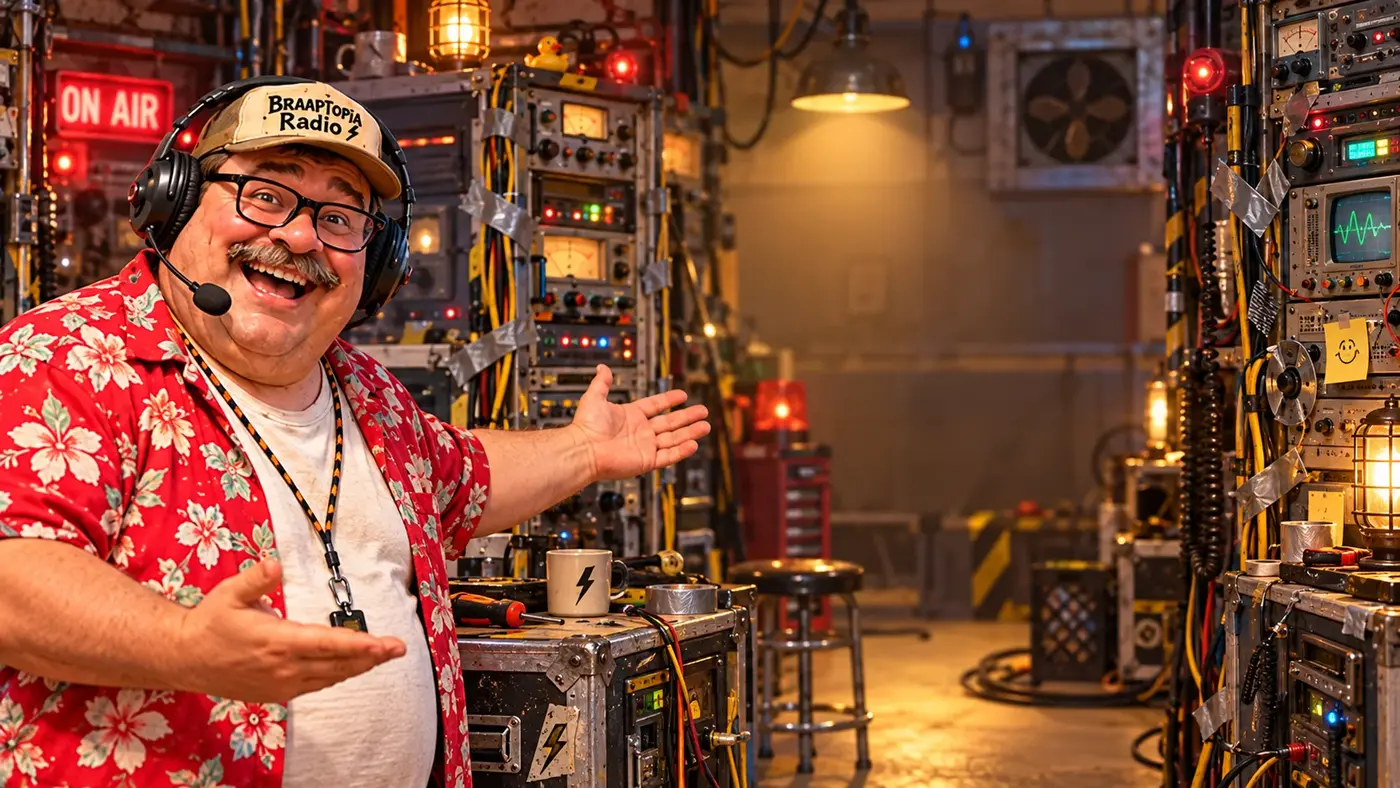
Every visitor to Braaptopia eventually becomes Engineering.
It usually happens without warning. You are standing near the radio studio, minding your own business, and a page comes over the speakers:
ENGINEERING TO STUDIO
You look around for an engineer. There isn't one. You wait for someone else to respond. Nobody does. A second page arrives, more urgent:
PAGE SENT
Waiting for somebody else to become responsible.
And then the third, which is not urgent at all, merely final:
NOPE. STILL YOU.
ORGANIZATIONAL CHART EXHAUSTED. SEARCH RESULT: YOU.
This is how it works at Braaptopia Radio. There is no engineering staff. The station's own public notice is quite clear about this: Hang around, turn it up, tour the studios, and meet the engineering staff. There isn't an engineering staff. A qualified one anyway. Have any zip ties? We should talk. When something breaks (and something always breaks) the problem is escalated to the same guy, and if that guy is busy, it falls to whoever is nearest. Responsibility, at Braaptopia, is not assigned by authority. It is simply what remains after everyone else has found something more important to do.
The official notice is posted on the door of the Engineering Arcade, and it is the most honest sign on the island:
ENGINEERING HAS BEEN NOTIFIED.
UNFORTUNATELY, YOU ARE ENGINEERING.
The Engineering Arcade
It stands on the resort grounds in a teal-and-weathered-wood building with a glowing purple neon sign, ENGINEERING ARCADE, and inside it is exactly what you would expect: rows of cabinets, flashing lights, the smell of hot electronics, and a room full of things that worked until somebody touched them. The cabinets have names like PATCH BAY, SMOKE TEST, SIGNAL ROUTER, BRAIN MELT and THE RACK.
Over the main entrance, in letters that look like they were stenciled during an emergency:
THE FAULT IS PROBABLY INTERMITTENT
And beneath that, a smaller sign: It only does it when nobody is looking. Inside, a hand-lettered notice declares: We repaired the warning light. The warning remains.
Radio Guy will meet you inside. He is, as always, absolutely thrilled to see you.
The Rack Caught on Fire.......... Again.
That is the full and official name of the work you are about to do. Note the dots. The dots are important. They are the sound of a man who has said this sentence many, many times. Around the station, people sometimes shorten it to Rack Go Boom, especially when writing on buttons, but the full title is the correct one, and Radio Guy will say it to you in full, with feeling:
"Welcome to The Rack Caught on Fire.......... Again. Around here, the station's technical problems become a spectator sport."
He explains the work as he would to a new hire, which you now are:
"Every work order is a quick-response maintenance crisis: sort supplies, defend the magic smoke, clear the access, reroute the signal, or untangle enough nonsense to keep the rack on air. The score goes up when you fix things. The magic smoke stays inside if you're lucky. Anything that looks professionally engineered was almost certainly an accident."
And then, with genuine warmth:
"The good news is none of this is complicated once you stop expecting it to make sense. Some days we inventory the food, some days we protect the magic smoke, some days we move half the room just to reach the thing that broke, and every so often the official repair procedure is to hit something until it remembers its job. Keep the station on the air, keep the smoke inside the equipment, and yell if you need me. I am genuinely thrilled to have the help."
He means it. He really is thrilled. In an organization this size, eight different kinds of emergency can happen before lunch, and he has been running out of hands.
The Eight Specialties
There are eight kinds of work in Engineering. You will learn them all, in order, on your first day, and then they will come at you in whatever order the station's luck decides.
Supply Logistics. First problem, says Radio Guy, apparently engineering requires inventory. You will sort through a chaotic stockpile of parts, tools, duct tape, zip ties, locking pliers, crimp connectors, wire nuts, multimeters, rack bolts, and whatever else somebody swears was here five minutes ago. Also collect the food. Yes, the food counts. Burritos, sausages, kielbasa, sauerkraut, mustard, salsa, chips, Pop-Tarts and pudding cups occupy the same shelves as the hardware. Around here, lunch and mission-critical repair stock have somehow become the same procurement category. Nobody works well hungry, especially near high voltage. If you run out of useful moves, the station applies its approved technical procedure: shuffle everything.
Magic Smoke Containment. Every electronic component leaves the factory with a carefully measured supply of magic smoke installed inside it. Our job is to keep it there. This is not a metaphor. At Braaptopia, it is engineering doctrine. When the magic smoke gets out, the equipment is dead, and it is not user-serviceable once it becomes atmosphere. You will stand in front of the rack with a rapid-firing maintenance defender, picking off incoming static, dust, and cheap power supplies as they swarm toward the expensive end of the room, through three rack sections: the Power Supply Cap Bank, the Exciter and Driver Section, and finally the Final Amplifier. And then there are the worms. Nobody calls them worms officially; the briefing calls it a segmented maintenance problem. They wind their way down through the equipment, and if you shoot one in the middle, congratulations: now you have two worms. By the final section there are two worms, more debris, the same magic smoke, and no pressure. If you fail, the station will report it with grim honesty: WE HAVE CONVERTED ELECTRICITY INTO SMELL. If you succeed, Engineering will declare it preventive maintenance, and stamp the report: ENGINEERING HAS DECLARED THIS COMPLETELY INTENTIONAL.
Tower Climbing. The beacon bulb. See §2. You have been volunteered.
Percussive Maintenance. Sometimes the official repair procedure is to hit something until it remembers its job. This is that procedure.
Ghost in the Rack. See §4, The Ghosts in the Rack.
Equipment Access. Sometimes nothing is electrically wrong yet. We simply cannot physically reach the electrically wrong thing. Somebody has parked road cases, crates, coolers, toolboxes, a folding table, cable bins and mystery equipment in front of the rack that has failed. Your job is to shove all of it out of the way, and pull it, too, because Braaptopia does not believe in making a hard job harder, so that Engineering can get a human body close enough to regret the decision. As Radio Guy says: Half of broadcast engineering is fixing things. The other half is discovering why there is a folding table, three road cases, and a box marked STEVE blocking the cabinet. Steve, you will recall, has not worked here in eight months.
Signal Routing. Braaptopia Radio only works if the audio makes the whole trip: studio to the signal path, signal path to transmitter, transmitter to antenna, antenna to everybody out there who somehow found us. When that route breaks, you rebuild it, one connection at a time, past decoy paths labeled AUX, TEST, SPARE, MON, OLD STL, BACKUP, REMOTE FEED and DO NOT USE. If the music stops halfway between Studio and the tower, the listeners do not care which box failed. They just know the station disappeared, which is generally frowned upon in broadcasting.
Cable Management. And then there are the cables. Broadcast facilities generate knots when nobody is looking. Extension cords, patch leads, power cables, audio lines and mystery wire apparently reproduce after dark and immediately become emotionally attached to each other. Untangling something is not a special engineering event. It is Tuesday. Red lines are crossed. Green lines are clear. Red bad. Green good. And try not to ask why a cable labeled TEMPORARY has been there since before anyone remembers.
That is the cycle, and Radio Guy summarizes it with something like pride:
"A problem appears, you get a work order, Radio Guy becomes unusually invested in your success, you fix whatever version of nonsense landed on the screen, and everybody enjoys roughly twelve seconds of confidence before the next thing needs attention."
When the work order is complete, the screen tells you the only thing that matters:
WORK ORDER COMPLETE
THE RACK REMAINS ON AIR
And if, after a long shift, you decide you have had enough, the station will let you go, with the formality of an HR process:
YOUR SHIFT HAS BEEN SUSPENDED. Engineering can always use the help. Your absurdly large ring of padlock keys will remain hanging by RACK GO BOOM for whenever you are ready to clock back in. Until then, thank you for the zip ties and the generous underwriting check. This means more sausages and burritos for everybody, which is apparently how infrastructure funding works here.
Some say there is a ninth specialty waiting to be discovered, that the cabinets in the Arcade were built in rows of three, and that one slot stands empty because Engineering refuses to fill it with anything that has not earned its place. Others say this is just how the cabinets were delivered.
The Rules of Engineering
You will pick these up quickly. They are posted around the Arcade, scrawled on tape across rack panels, and repeated by Radio Guy whenever something goes wrong:
- If it works, don't touch.
- Keep it on air.
- Red bad. Green good.
- If it smells hot, stop touching it.
- Nothing is overloaded until the breaker votes.
- The backup system is also the primary system.
- That knob was fine until somebody improved it.
- Temporary has entered its fifth season.
- We fixed it by explaining it to it.
- It tested good immediately after the threatening.
- Contact cleaner remains heavily involved.
- Coffee remains approved diagnostic equipment.
- Grab whatever tool looks least alarming.
- Do not eat the parts inventory unless it is clearly one of the parts inventory items that is also lunch. You will know the difference eventually. Probably.
The Engineering Bulletins
The station's emergency alert system was originally meant for real emergencies. It has since been repurposed, informally, as a running log of Engineering's adventures. It scrolls across the bottom of every screen in the studio:
BRAAPTOPIA CIVIL DEFENSE: THIS IS ONLY A TEST OF THE LOUD THING. ✦ NO ACTION IS REQUIRED. SOMEBODY FOUND THE BUTTON. ✦ EAS UPDATE: TRANSMITTER CABINET OPEN. ENGINEER INSIDE EMOTIONALLY. ✦ EAS UPDATE: BLUE SMOKE REPORTED. SOURCE SAYS IT WAS "MORE GRAY THAN BLUE." ✦ EAS UPDATE: ONE POWER STRIP HAS BEEN PROMOTED BEYOND ITS DESIGN INTENT. ✦ EAS UPDATE: RACK FAN HAS ENTERED ITS VOCAL ERA. ✦ EAS UPDATE: ENGINEER FOUND THE PROBLEM. IT WAS NEAR THE OTHER PROBLEM. ✦ EAS UPDATE: SOMEONE SAID "DON'T TOUCH THAT" AND THREE PEOPLE TOUCHED IT. ✦ EAS UPDATE: REFLECTED POWER HAS BEEN ASKED TO LEAVE. ✦ EAS UPDATE: GROUND LOOP HAS BEEN RECLASSIFIED AS AMBIENCE. ✦ EAS UPDATE: CIRCUIT BREAKER HAS CAST ITS VOTE. ✦ EAS UPDATE: UPS BEEPING. EVERYBODY PRETENDING NOT TO HEAR IT. ✦ EAS UPDATE: SOMEONE HAS LOCATED THE SERVICE MANUAL. IT IS FOR ANOTHER MODEL. ✦ EAS UPDATE: THE ENGINEER HAS SAID "HMM" THREE TIMES. CONDITION UPGRADED. ✦ EAS UPDATE: RED LIGHT CLEARED AFTER DIRECT NEGOTIATION. ✦ EAS UPDATE: ENGINEER HAS GONE TO GET A LONGER SCREWDRIVER. ✦ EAS UPDATE: THIS IS NOT AN EMERGENCY. IT IS JUST HOW THE RACK LOOKS. ✦ EAS UPDATE: EVERYTHING WORKS AGAIN. NO ONE IS CERTAIN WHY. ✦ EAS UPDATE: DO NOT CHANGE ANYTHING. THIS IS NOW THE GOLD BUILD.
The Station Emergency Action Panel
In a place of honor in the studio, behind a sheet of scratched plexiglass that does not lock, is the Station Emergency Action Panel. Its placard reads:
Big buttons. Terrible judgment. Professionally handled consequences.
The buttons are as follows: ACTIVATE PROFESSIONALISM. FIRE TOWER. SEND INTERN. BLAME TRANSMITTER. PANIC QUIETLY. TEST LOUD THING. DEPLOY BACKUP DJ. JIGGLE COAX. REBOOT OPTIMISM. CLEAR ALARM LIGHT.
And along the bottom, spanning the full width of the panel, in red:
DON'T TOUCH THIS
Each button does exactly what it says. Professionalism, at Braaptopia, is a subsystem that can be switched on in an emergency. Optimism can be rebooted. The Intern can be sent. The tower can be fired, and when it is, flame erupts from the great sign at the top. When you press JIGGLE COAX, the whole station lurches: the music warbles and crackles and drops out, static washes over everything, and for a few awful seconds you think you've broken it. Then it comes back, and the readout calmly informs you:
COAX JIGGLED. RF PATH RESPONDED WITH A SERIES OF UNHELPFUL OPINIONS.
Don't Touch This
Every person who has ever worked in radio knows the feeling. There is a box in the rack, the audio processor, the thing that shapes how the whole station sounds, and somebody senior has told you, very firmly, never to touch it. And from that moment on, you want nothing more in the world than to touch it.
At Braaptopia, you are allowed. In fact, the button practically begs.
Press DON'T TOUCH THIS and a real, working, live audio processor opens up in front of you, wired straight into the station. Bass. Midrange. Treble. Stereo width. Compression, here labeled Smash. Output gain. And at the bottom, comically, enormously longer than all the others, a slider labeled:
TRANSMITTER VIOLENCE
0 — — — — — — — — — — — 11
It goes to eleven. Of course it goes to eleven. A note from Engineering is printed beside it: Yes, but this one goes to 11. The settings along its length have names: Adult Supervision. Public Radio. Commercial FM. Processor Has Opinions. Chief Engineer Left Early. Warranty Void. Ludicrous.
You will push it all the way up. Everyone does. And the station will roar out of every speaker on the island sounding, as one of its builders put it, badly exactly how I think it sounds good.
There is a second, older rack nearby called ILLEGAL AUDIO ENGINEERING, which has knobs labeled Dirt Glue, Braap Presence, Sunday Shine and Legal Ceiling, and a single button that reads MAKE THIS SOUND LIKE RADIO. Its posted philosophy is simple: No one who has worked in radio has escaped the urge to touch a knob they should not touch.
Test the Loud Thing
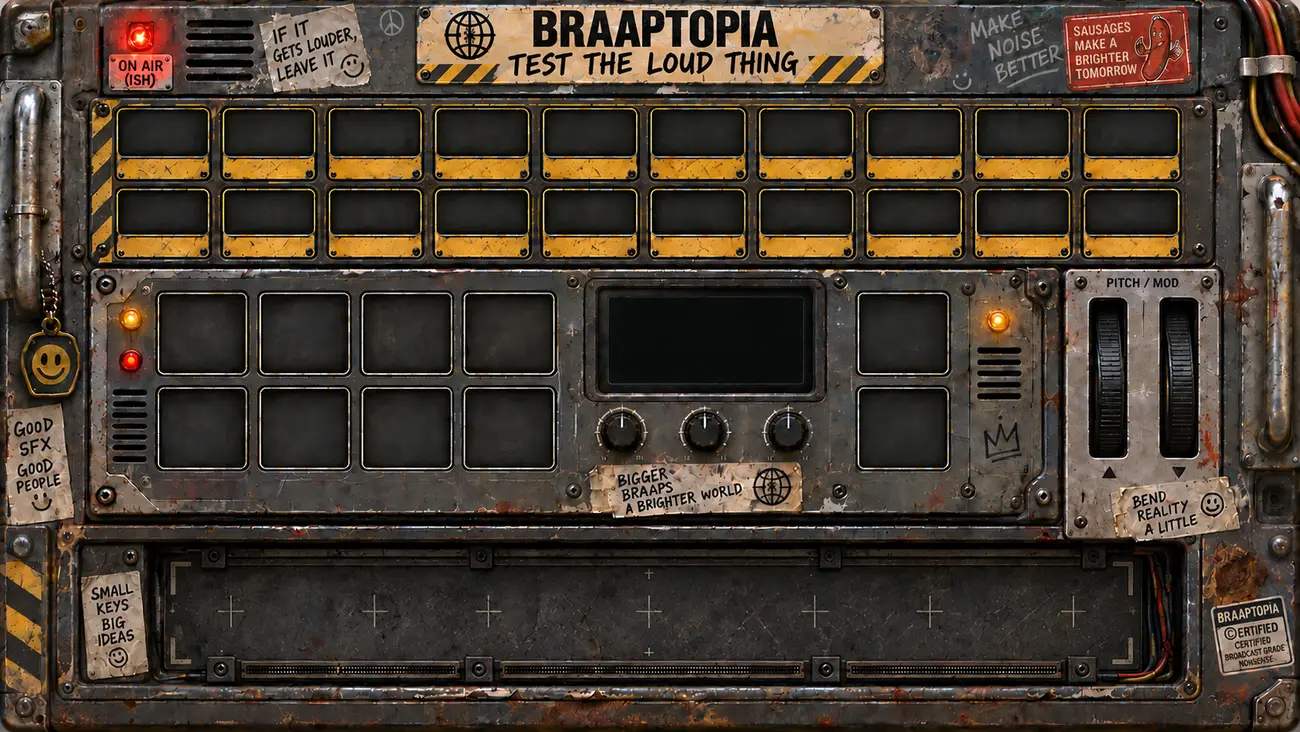
And then there is the Loud Thing.
It sits in its own corner of the studio, and it looks like it was salvaged from a decommissioned submarine, then customized by somebody with a label maker and no adult supervision. It is a battered, rusted, grime-streaked industrial sampler, a vast metal console with twenty pads across the top, ten big dark pads below them, two wheels, three knobs (LOUD, DIRT and TAIL), a green screen, and a full two-octave keyboard tuned so low that it rattles the floorboards. Its name is stenciled across the top:
BRAAPTOPIA
TEST THE LOUD THING
Each of the top twenty pads plays a sound. BRAAAAAAP. COW MOO. ROOSTER. BOOM. PEW PEW. BOING. WHEEEEE! FAIL. BABY LAUGH. FAIL HARDER. WONK WONK WHA. FANFARE. POWER UP. CARTOON JUMP. YAY. PANIC. GLASS SHATTER. PARTY HORN. ROBOT PANIC. And one pad, labeled only THE TOOTER, the sound of which shall not be described in a family publication.
The ten lower pads are dark. They are reserved, according to a strip of tape across them, for a future bank of industrial sounds: machine impacts, hydraulic thunks, metal hits and sub-bass drops, to really crank this thing up to 11. They have not arrived yet. The keyboard waits for them.
You may play any of the sounds on the keyboard. You may load one sound into the lower half and another into the upper, and play them against each other. And if you load the cow into the keyboard and play it fast, low and in rapid succession, a strange thing happens. The cow begins to sound like a dirt bike. Nobody designed this. Nobody can explain it. And when it was discovered, the decision was made, swiftly and unanimously, that we aren't changing that.
The Loud Thing's screen reports on your testing in the deadpan language of a laboratory instrument:
BRAAPTOPIA AUDIO WORKS
NO USEFUL MEASUREMENTS TAKEN
LOUD THING READY
TEST FIRED: COW MOO
PROGRAM AUDIO CONTINUES
NOBODY ASKED WHY
THIS IS NOW A MUSICAL INSTRUMENT, APPARENTLY
There is a button on the screen marked CHAOS. Press it, and the Loud Thing fires a random burst of everything at once.
CHAOS TEST IN PROGRESS
MULTIPLE DEPARTMENTS NOTIFIED INCORRECTLY
PLEASE DO NOT IMPROVISE A PROCEDURE
CHAOS TEST COMPLETE
RESULTS: LOUD
USEFUL DATA: NONE
There is also a button marked STOP. It works.
ALL LOUD THINGS STOPPED
THE RADIO SOMEHOW SURVIVED
ENGINEERING CLAIMS THIS COUNTS AS DATA
And through all of it, the live station keeps playing underneath. You are not in a sandbox. You are on the air. As the screen helpfully points out:
PROGRAM AUDIO CONTINUES UNDER THIS ENTIRE BAD DECISION.
If you reach the Loud Thing by way of the Emergency Action Panel instead of the studio door (if you press TEST LOUD THING in an emergency) the sampler opens and immediately fires one Chaos burst on its own, before you can touch anything, which is what an emergency test is for.
Brain Melt
There is a door at the back of the studio with a warning on it. The warning is serious. It is the only serious sign on the island. It tells you that what lies beyond contains intense flashing lights and strobing color, and that you must confirm you understand before you enter.
Beyond that door is Brain Melt.
Brain Melt is what happens to Braaptopia Radio's music when it is turned into light. The walls dissolve into tunnels that pulse with the bass. Grids twist and ripple like a flag in a hurricane. Solar flares burst from the center of the screen and whirl through stop-motion rotations; the effect is described, approvingly, as total chaos… as it should be. A Feedback Bloom coils and springs like an insane slinky. A giant oscilloscope scribbles Lissajous figures across the room. A Hypno Wheel spins in colors that do not occur in nature. Terrain rises and falls in contour ridges with the beat. There is a radar screen called Braap Radar, a spray of dirt called Roost Burst, a smeared old television called CRT Jam, and a thing called the Clamshell Mouth that opens and closes in time with the music in a way that is either hilarious or deeply unsettling, depending on the song.
And there is The Knee Dragger. Nobody set out to make The Knee Dragger. It began as an abstract pattern, and then someone tilted it, and suddenly it was a road rushing beneath you at well over a hundred miles an hour, the white lines whipping past, the horizon tilting, the sensation of a motorcycle laid so far over in a corner that your knee is skimming the asphalt. It was supposed to be something else. It became this. It was given a name, and it was never changed back.
Every time a new song starts, Brain Melt chooses a new vision. Every time the station plays a liner, the great BRAAPTOPIA RADIO logo fills the screen. And every so often, without warning, the house band hijacks the signal. Their faces burst into the middle of the light show in a blaze of purple, uninvited, for a few seconds of chaos, and then they are gone again. Nobody authorized this. Nobody has stopped it.
There is a lighter version for phones, called Mobile Jam, which looks every bit as wild and runs cool enough that someone once watched it for over an hour with no heat and declared the result, simply, winning.
A Booth That Has Opinions About Coax
A visiting critic once described Braaptopia Radio this way, and the station was so pleased that it put the quote on its front page:
"I have not seen another hobby radio toy that committed this hard on both sides at once: production library and a booth that has opinions about coax."
That is the station, exactly. It is, on one side, a genuinely enormous library of music, hundreds of songs strong. On the other side, it is a building full of equipment that has opinions. Opinions about coax, about grounding, about reflected power and how the transmitter is feeling today. The station is designed so that you can simply leave it running, on a screen in the corner of your room, and watch it live its life. Requests arrive. Tickets update. The tower reports. The cameras switch. The talkback crackles. The goat clarifies. The crawl scrolls past with news of a fender that has independent career plans. You cannot keep up with all of it. You are not meant to. As one of the people who built it said: You really can't keep up with all of it, which is exactly how a radio station should feel.
§4 · The Ghosts in the Rack
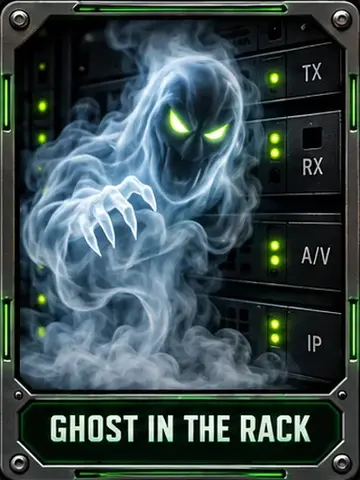
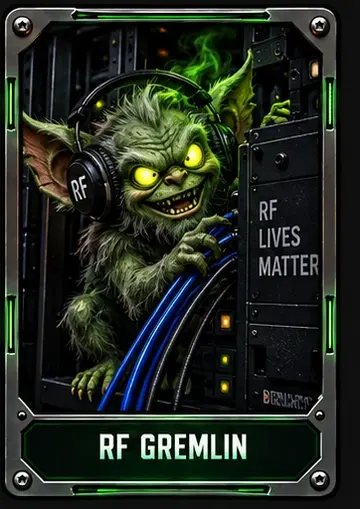
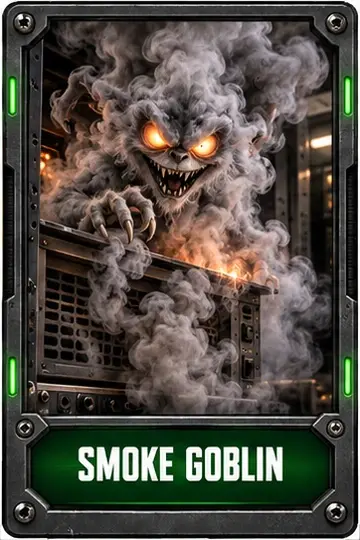
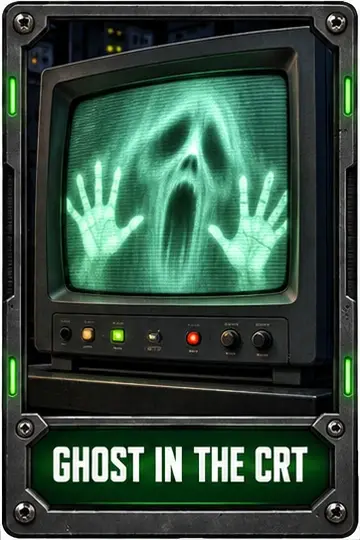
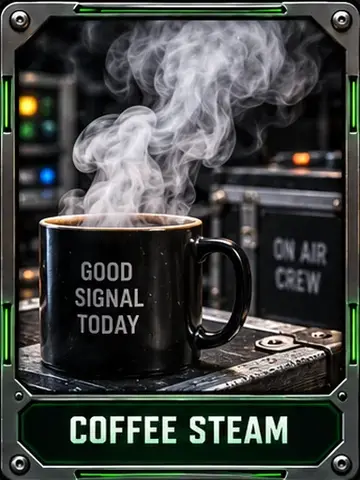
Every broadcast engineer in the world knows about the intermittent fault.
It is the problem that only happens when nobody is watching. The crackle that stops the moment you put your ear to the speaker. The dropout that never drops out while the test equipment is plugged in. The light that blinks red all night and turns green the moment the engineer walks into the room. In most places, engineers call it an intermittent and swear at it.
At Braaptopia, they have found out what it actually is.
It is a ghost.
S.P.E.C.T.R.E.
Deep in the station's engineering wing is a training facility with a name so grand that it sounds as though a government built it:
S.P.E.C.T.R.E.
SIGNAL PATH EQUIPMENT CLASSIFICATION,
TROUBLESHOOTING & RACK EVALUATION
It is the station's high-tech engineering training simulator. Nobody knows how a station with no budget came to own a high-tech engineering training simulator. Nobody knows how it works, Engineering will tell you. Lean into it. Radio Guy runs the training, part drill sergeant and part supportive friend, and he will brief you on the job ahead as though it were the most ordinary thing in the world, because at Braaptopia it is:
Finding ghosts in the rack is a daily job around here.
The Hallway
The simulator is a long hallway lined with broadcast equipment, built like a stage set: the walls are painted scenic flats of rack banks, patch fields, power walls, repair benches and microwave labs, all receding into perspective toward a distant back wall crammed with more equipment than any one wall should hold. A glowing light strip runs down the center of the ceiling. There is, as one of the people who built it put it, more broadcast equipment at the end of this ridiculous hallway.
You advance down the hall, one stage at a time. At each stage, a set of cards stands waiting, face-down, in a little pyramid. They flip. And you have a moment, only a moment, to decide which of them show something that is actually wrong.
Some of them are faults. Some of them are perfectly innocent. Everything, the training manual explains, should look like something weird happening in a radio station. Some of it is actually broken. Some of it is just Braaptopia.
Actual Faults: Tag These
Ghost in the Rack · "The intermittent has become visible. This is your moment." RF Gremlin · "Something with tiny malicious intentions is living in the RF path." Rack Poltergeist · "The rack room ghost has decided to stop being subtle." Patchbay Phantom · "That patchbay now appears to be haunted end-to-end." Gremlin Nest · "That equipment bay is actively hosting goblin infrastructure." Haunted Power Supply · "The power supply has developed visible paranormal side effects." Spectral Short · "The short circuit has gone fully supernatural." Smoke Goblin · "The smoke goblin is back and it brought witnesses." Ghost in the CRT · "The monitor is now displaying a genuinely unhelpful spirit." RF Mischief · "There is definitely malicious energy in the feedline today." Magic Smoke Leak · "Factory-installed smoke is outside the equipment." Arc Fault · "The wiring is attempting its own lightning demonstration." Burning Wall Wart · "The wall wart has advanced to open flame operation." Sparking Coax · "That connector is absolutely up to something." Runaway Fan · "Cooling fan has entered the hardware-removal phase." Water on Power · "Water and mains voltage have scheduled an unsupervised meeting." Alarmed Module · "The module is using every red light it owns." Power Strip Overload · "That outlet cluster is one plug away from a spiritual event." Leaking Capacitor · "That capacitor is venting its feelings into the chassis." Frayed Extension · "That extension cord has become more copper than insulation." Runaway Blower · "The blower is now an enthusiasm problem." Overheated Transformer · "That transformer looks one argument away from smoke."
Leave These Alone: Non-Threats
Coffee Steam · "Coffee remains approved diagnostic equipment." Bench Test Leads · "Those leads are exactly where engineering left them." On-Air Light · "Red is normal when the microphones are live." Vent Fan Normal · "That fan is noisy, dramatic, and completely fine." Parts Bin · "That bin is full of future solutions, not current faults." Scope Static · "That ugly waveform is presently somebody else's problem." Vacuum Tubes · "Those tubes are old-school, dramatic, and presently fine." Service Light · "The work light is supposed to look bright and slightly accusatory." Zip Ties · "Those zip ties are just waiting for their big moment." Coffee Thermos · "Hydration and caffeine are not targetable offenses." Maintenance Log · "The paperwork is suspicious, but not hostile."
The trick, of course, is that they all look alike. The ghost in the rack is a wisp of pale vapor behind the equipment. So is the coffee steam. The arc fault is a bright crackle of electricity between two wires. So is the bench test lead clipped where Engineering left it. Some of the safe cards are full of red lights, steam, glowing tubes, and alarming tangles of cable. Some of the faults look almost peaceful. You must look. You must decide. And if you hesitate too long, the fault simply ducks back into the rack, and the hallway announces your failure with weary familiarity:
IT STOPPED DOING IT AGAIN
Radio Guy will shake his head. Of course it stopped the instant engineering looked directly at it.
The Rooms
The simulator moves you through four rooms, and each has its own notice posted at the door:
RACK AISLE — The fault only happens when nobody is looking.
PATCH BAY — Everything marked TEMPORARY has been here since 2009.
TRANSMITTER ROOM — The loud machinery has started developing opinions.
QUESTIONABLE BACK ROOM — Engineering says this room is probably supposed to exist.
That last one is worth pausing on. Nobody at the station is entirely sure the Questionable Back Room is meant to be there. It does not appear on any floor plan. Its door is not mentioned in any lease. Engineering has examined it and concluded, after careful study, that it is probably supposed to exist. Nobody goes in there without a flashlight.
The Closeout
When the simulation ends, the lights in the hallway dim. The rack room glows faintly behind a translucent report, and you are presented with your Engineering Closeout: a formal performance evaluation listing every fault presented and every fault correctly identified, every innocent piece of equipment you mistakenly attacked, your best combo, your average fault response time in seconds, your non-threat discipline, and your overall engineering judgment.
And in the upper corner, circled in red pen, in the shaky handwriting of a disappointed schoolteacher, is your grade.
If you did very well, you may receive the station's highest assessment: SUSPICIOUSLY PROFESSIONAL. The ghost has been caught. The report will say so:
GHOST CAUGHT IN THE ACT
The intermittent fault has been observed, tagged, and publicly embarrassed.
And at the bottom of the report, a final note, from Engineering, to temper your celebration:
It will probably behave perfectly for the next three weeks.
Concerning the Supernatural
You will notice, perhaps, that nobody at Braaptopia seems particularly surprised that the station is haunted.
This is because, at Braaptopia, it isn't haunted. It simply has faults. Some of those faults are bad capacitors, and some are frayed extension cords, and some are a translucent shrieking spirit trapped inside a twenty-year-old monitor, and they all go into the same work-order queue, and they are all handled by the same people, in the same way, with the same tools. There is no special supernatural emergency protocol. There is no exorcist on call. There is a clipboard, a flashlight, a cup of coffee, and someone who has been volunteered.
A hallway full of nothing but ghosts would be a fairy tale. A ghost appearing among the coffee steam and the vacuum tubes and the bad capacitors, filed in the same queue as an overheated transformer, is Braaptopia.
ON AIR · BRAAPTOPIA RADIO
Couple of announcements from Engineering. First: the smoke goblin is back. Second: the smoke goblin has brought witnesses.
I've been asked to remind everyone that if you see a ghost in the rack, do not panic. Tag it, write it up, and leave it for the next shift like a professional. If you see a ghost in the CRT, that's a different form. That's the green form. Green form's in the drawer next to the burrito drawer, which, as we've discussed, does not exist.
Okay! Here's the forecast: tacky in the trees, powdered donut in the open. Back to the music.
AppendixThings Nobody Will Explain
Every island has its mysteries. Braaptopia keeps its own on purpose. They are collected here, not so that you might solve them, but so that you will know which questions to stop asking.
- Radio Guy's real name. Radio people use names that are not their own. This one stopped needing one.
- How the bus got to the island. Eight witnesses. Eight accounts. One propeller.
- Whether the bus was amphibious before Vern worked on it.
- When the replacement part is coming. Ruby ordered it. The supplier needs to know whether it's a bus or a boat.
- What the guitarist knows. He smirks. He says nothing. Leon suspects.
- Why Radio Guy is always first at the fire. It is a professional instinct. Probably.
- Why the truck has jet engines. It is a remote broadcast vehicle. Radio Guy has to get out to the islands somehow.
- How the sign got to the top of the tower. How do you think?
- How a station with no budget afforded all its toys. Nobody knows. Lean into it.
- Where all the infrastructure came from. Internet.
- Where the bridges went. You know what bridges would've cost?
- How the bay got bigger. It was an improvement.
- Why the goat keeps insisting it is not a raccoon. Nobody accused it.
- Who runs the sausage cart.
- Who Earl is, and what he heard.
- Where Steve went. He has not worked here in eight months. His pudding cup has seniority.
- Who management is. Last known location: near a lake.
- Whether the Questionable Back Room is supposed to exist. Engineering says probably.
- What is on the Webb clipboard. Do not ask about the clipboard.
- Why the van's top speed has to be forty-two.
- Who Bob is, and why his ejection seats are so reasonably priced.
- Who Dave is, and where his Wing Shack might be.
- Who the CEO is on the Island Hopper's Executive Playtime run.
- What the unlabeled button in the hotel elevator does.
- How the band got on the payroll when nobody is officially employed.
- What exactly Willie does at the radio station.
- Where the burrito drawer is. There is no burrito drawer.
- Where the ten-millimeter socket is. It was on the workbench. Nobody will admit this. It is missing again.
AppendixA Short Glossary of Braaptopian
Braap (n., v., interj.). The sound of a machine being asked to do too much and agreeing. Also a greeting, a farewell, and a technical explanation.
Full Send (n., v.). Committing completely, at full throttle, to a decision that has not been fully thought through. See also: the Three Laws.
Play Dirtier. The resort's motto. Not a suggestion.
More Hits Than the Guardrail. The station's motto. Also true.
Hero dirt (n.). Perfect, tacky track surface that makes everyone look like a hero. Lasts approximately three more laps.
Roost (n.). The spray of dirt thrown by a rear tire. Visible, on good days, from the county line.
Holeshot (n.). Getting to the first corner first. Sometimes declared extremely holeshotty.
Magic smoke (n.). The smoke that comes installed in every piece of electronic equipment at the factory. Engineering's job is to keep it inside. Not user-serviceable once it becomes atmosphere.
Intermittent (n.). A fault that only happens when nobody is looking. Also, in Braaptopia, a ghost.
Temporary (adj.). Of indefinite duration. Often since 2009.
Temporary with paint (adj.). A more permanent class of temporary.
Percussive maintenance (n.). Hitting something until it remembers its job.
Funky Organized Chaos (n.). The station's practice of slipping a liner in before every requested song. Also a fair description of the island.
Liner (n.). A short station identification. Usually sung. Usually loud.
Remote (n.). A live broadcast from somewhere other than the studio, typically a folding table behind a pickup truck at Turn 2.
Coax (n.). The cable that carries the signal from the transmitter to the antenna. It has opinions. It may be jiggled.
Ten mil (n.). The ten-millimeter socket. See: Appendix, Things Nobody Will Explain, item 28.
WTF (n.). Waylon "Torqued" Ferguson. Everything flight-wise goes through him.
WWW (n.). Wingin' It Workshop Web. The Internet of Questionable Solutions. Also Waylon, Willie and Webb.
Braap Bucks (n., provisional). A currency the island has not yet admitted to having.
Driver / rider. You drive the Rally car, the Trophy Truck and the SXS. You ride the ATV and the dirt bike. This is enforced.
Probably (adv.). Yes.